A distributed system is a collection of collaborating, concurrent components that communicate by sending and receiving messages over a network. Its behavior emerges from both the components and their interactions. Distribution supports correctness, scalability, and reliability because one component cannot handle unbounded load or survive inevitable failures alone. section 1.0 section 1.9
Each component exclusively controls its local state, while the network controls messages in flight. The system can be modeled as a state machine: one component or the network takes one discrete step at a time, either communicating externally or computing internally. section 1.4 section 1.3.1
Reason about a distributed system through several complementary dimensions:
- Model the network either as a shared communication bus with message buffers or as a bus whose components hold those buffers; both models capture loss, duplication, and reordering. section 1.3.1
- Change resolution by treating a subsystem as one component or as a collection of communicating components; holons and holarchies help represent these nested organizations. section 1.5.1
- Separate the global view from the local view: an observer may see the whole system, but each component sees only its own state and limited information. section 1.7.3 section 1.7.4
- Judge the resulting guarantees through correctness, including safety and liveness, alongside scalability and reliability. section 1.9
Distributed Systems Incorporated
Imagine an office building whose rooms are independent components, pneumatic tubes carry messages between rooms, and a mailbox connects the building to the outside world. A worker may lose, duplicate, or reorder messages; workers may also pause or leave. Simple local rules can therefore produce complex system behavior. section 1.6 section 1.7.1
Figure 1.2 Different models describing the same aspects of a system. (The sets of facts for each model completely overlap.)
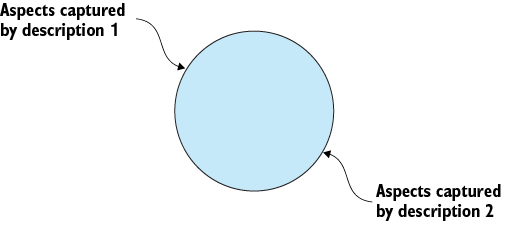
Compare equivalent models of the same distributed system to see which facts remain unchanged when message buffers move between the network and components. section 1.3.1
Figure 1.18 Splitbrain
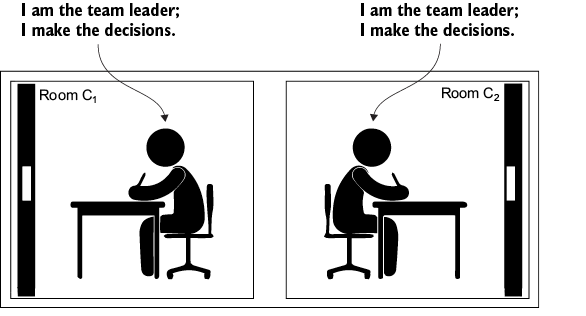
Use the split-brain illustration to examine how components with local knowledge can violate a global requirement such as having exactly one leader. section 1.7.4














