A domain is a subtree of the hierarchical Domain Name System (DNS) under the administrative control of an organization or individual. The hierarchy begins with the root domain (.), continues through top-level domains such as com, and contains second-level domains and deeper subdomains. section 3.1.3 section 3.3
Read domain names from the specific name toward the root:
- google is a second-level domain under the com top-level domain. section 3.1.3
- www.google.com identifies a name below google.com; each domain is a subdomain of the domains above it. section 3.1.3 section 3.3
- A fully qualified domain name specifies its exact position in the hierarchy, while a partially qualified domain name contains only partial information. section 3.3
- The name www conventionally identifies a web server; it is not a technical requirement, and many sites omit it. section 3.1.3
DNS resolution
When a browser requests https://www.google.com/maps, DNS translates the URL authority, www.google.com, into an IP address. The client can retain that mapping in its DNS cache. section 3.3
Figure 3.3 The DNS hierarchy. All domains are under the root domain, represented by “.”. Under the root domain, there are various top-level domains. Under each top-level domain, there are various second-level domains. The “google” domain, a subtree under the “com” top-level domain, is highlighted.
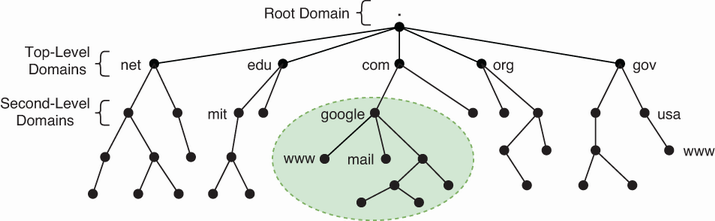
Trace the root domain, top-level domains, and second-level domains in a visual hierarchy, including google under com. section 3.1.3




