An ontology maps relationships between types of things in a domain. In intelligent search, it helps represent relationships that keywords alone cannot capture, including explicit and implied connections between concepts. section 2.0 section 2.4
Ontologies occupy a middle layer in domain knowledge modeling: taxonomies classify things into categories, ontologies connect types of things, and knowledge graphs instantiate those relationships with particular entities. section 2.4
Distinguish the main knowledge-modeling layers:
- Taxonomy: classifies things into categories, such as human, mammal, and animal. section 2.4
- Ontology: expresses relationships between types, such as human is mammal and mammal is animal. section 2.4
- Knowledge graph: instantiates an ontology with related things, such as John is human and John eats food. section 2.4
- Synonyms and alternative labels support the surrounding search vocabulary, mapping equivalent or related term sequences to domain entries. section 2.4
Figure 2.12 Levels of domain-specific knowledge modeling. Knowledge graphs extend ontologies, which extend taxonomies. Synonyms extend alternative labels and map to entries in taxonomies.
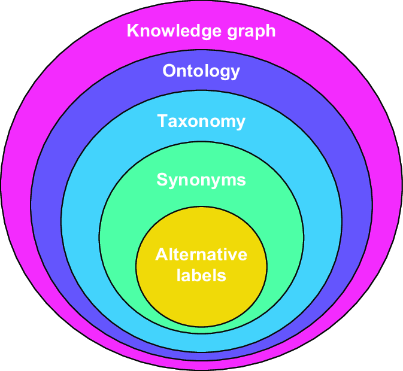
Use the modeling-level diagram to see how knowledge graphs extend ontologies, how ontologies extend taxonomies, and how synonym structures relate to alternative labels. section 2.4
In search systems, ontologies form part of a broader progression from keyword search toward richer domain understanding, alongside taxonomies, synonym lists, alternative labels, knowledge graphs, and semantic techniques. section 2.0 section 2.7


