An ontology is a formal vocabulary and conceptual structure for a domain. It defines named concepts, properties, categories, relationships, identities, differences, and constraints so heterogeneous data can be interpreted consistently and support inference. section 1.6.1 section 3.0
Taxonomies organize broader–narrower hierarchies; ontologies extend them with richer semantics such as synonymy, disjointness, unions, complements, and cardinality restrictions. A vocabulary without these relationships remains ambiguous. section 1.6.1
Use an ontology as a practical integration and reasoning layer:
- Choose a reference vocabulary for incoming XML, CSV, JSON, relational, document-oriented, or text data. section 3.0
- Map each source element to ontology concepts, properties, and relationships, creating a shared interpretation across origins. section 3.0
- Select only the semantic features needed for current business or clinical goals, leaving partial ontologies extensible. section 1.6.1
- Load the ontology before ingesting domain data, then use its structure for graph construction, analysis, and reasoning. section 3.3
Ontology-driven construction follows a goal-driven pipeline: understand the business or clinical need, inspect the data, prepare and map it, create or update the knowledge graph, and define queries that support users. The ontology mediates between local schemas and a unified graph representation. section 3.0 section 7.6
Healthcare ontology and annotated evidence
The Human Phenotype Ontology provides a reference structure for linking diseases with observable phenotypic abnormalities. A disease–phenotype annotation becomes a graph relationship, while provenance, author, creation date, and source become relationship properties. This preserves multiple evidence-bearing annotations instead of collapsing them into an unqualified edge. section 3.2.1
Ontology-guided disambiguation
A biomedical system can recognize “Zika,” retrieve candidate SNOMED concepts such as Zika Virus and Zika Virus Infection, then compare candidates through the ontology’s hierarchy and relationships. Shortest paths can be translated and summarized as contextual evidence for the final mapping. section 8.4 section 8.6
Figure 3.1 Mental model of the KG construction process as a specification of the CRISP-DM model, from understanding the business goal to defining the KG queries that support clinicians’ activities
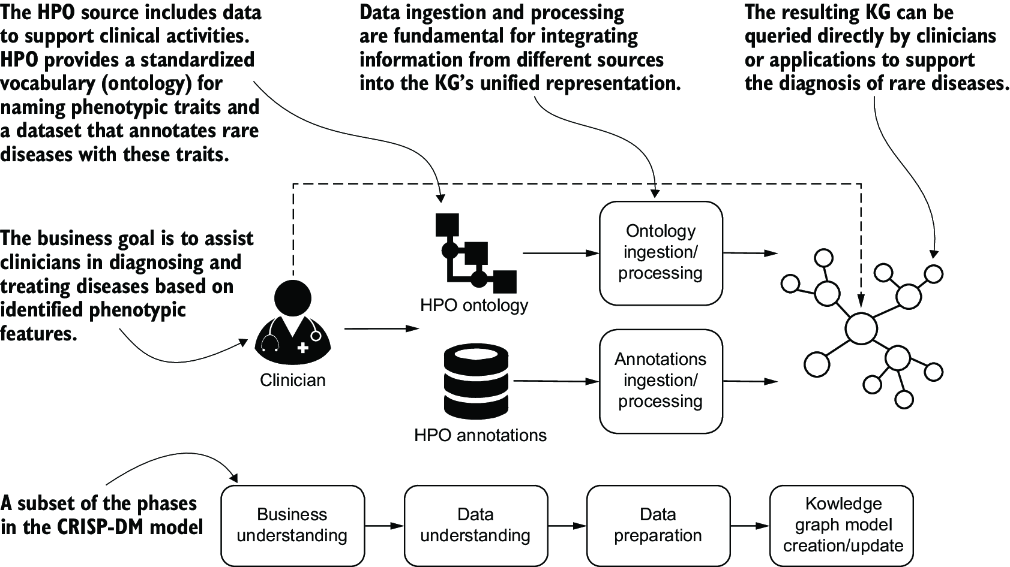
Use the construction-process mental model to connect business goals, data understanding, ontology-based KG creation, and clinician-supporting queries. section 3.0


