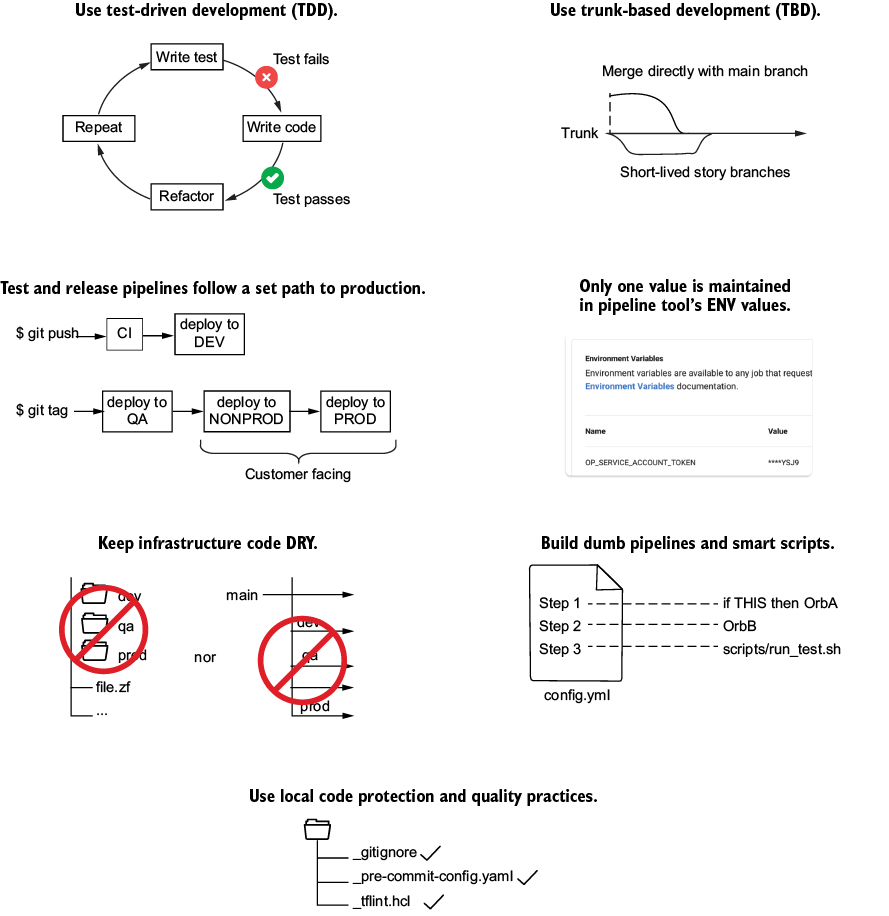
The DRY principle keeps knowledge and logic in one authoritative representation instead of duplicating it across infrastructure, credentials, environments, or pipelines. section 6.3.3
Apply DRY by:
- Pulling secrets from a secrets manager when needed rather than copying them into pipeline-tool environment stores. section 6.3.3
- Sharing infrastructure code across environments and expressing differences through configuration parameters such as tfvars. section 6.3.3
- Keeping pipelines focused on ordering while reusable, versioned scripts or pipeline libraries contain shared logic. section 6.3.3
Environment-specific infrastructure
Instead of maintaining separate infrastructure folders or long-lived branches for each environment, reuse the same code and supply environment-specific parameters. section 6.3.3
Figure 6.10 Well-architected Infrastructure-as-code pipelines are no different from well-architected regular software pipelines. This is why we prefer the term “software-defined infrastructure” to differentiate between simply using an infrastructure-as-code (IaC) framework like Terraform and the software engineering practices that are a part of sustainable, high-quality software developer lifecycle management of an engineering platform product.
Relates DRY infrastructure practices to software-defined infrastructure and well-architected delivery pipelines. section 6.3.3









