liveBook · Manning

Autoscaling

As explained in Google Anthos in Action

Scaling is the adjustment of computing resources or system capacity to handle changing workload demand.

Autoscaling adjusts application or infrastructure capacity as workload demand changes. In serverless platforms, the platform handles scaling while developers deploy containerized services rather than managing underlying compute. section 9.1 section 9.2.1

Implementation choices include:

  • Scale containers from incoming requests, including scaling resources to zero when no workload is active. section 9.1 section 9.2.1
  • Tune Knative services with concurrency limits and minimum or maximum container instances. section 9.2.1
  • Choose horizontal or vertical infrastructure arrangements when scaling Kubernetes environments across teams, stages, or locations. section 11.1.1

Cluster autoscaling can help control costs and enforce minimum resource requirements. Treat deletion as an operational dependency: remove node pools before deleting the cluster, and protect SSH keys with a system such as HashiCorp Vault for retrieval and rotation. section 5.6.2

Request-driven service scaling

Deploy an HTTPS-serving container to Cloud Run. The platform scales its container instances according to requests, while the service can use any language capable of answering HTTPS calls and does not require Anthos. section 9.1

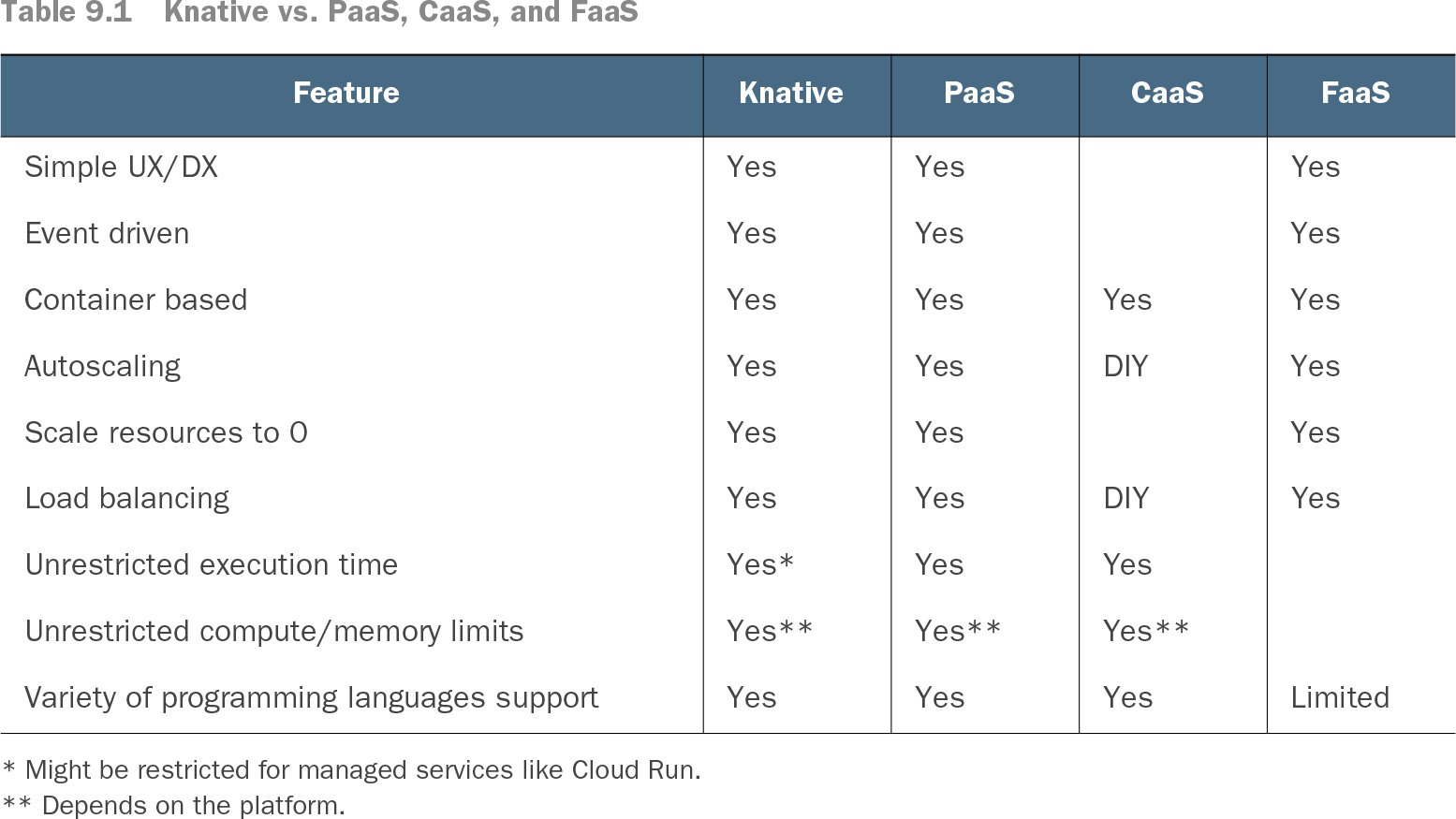
Table 9.1 Knative vs. PaaS, CaaS, and FaaS (view table figure)

Feature

Knative

PaaS

CaaS

FaaS

Simple UX/DX

Yes

Yes


Yes

Event driven

Yes

Yes


Yes

Container based

Yes

Yes

Yes

Yes

Autoscaling

Yes

Yes

DIY

Yes

Scale resources to 0

Yes

Yes


Yes

Load balancing

Yes

Yes

DIY

Yes

Unrestricted execution time

Yes*

Yes

Yes


Unrestricted compute/memory limits

Yes**

Yes**

Yes**


Variety of programming languages support

Yes

Yes

Yes

Limited

* Might be restricted for managed services like Cloud Run.

** Depends on the platform.

Compare autoscaling, scale-to-zero, load balancing, execution limits, and language support across Knative, PaaS, CaaS, and FaaS. section 9.2.1


How Google Anthos in Action covers it

How deep it goes
Explains request-based scaling, scale-to-zero, tuning parameters, and cluster trade-offs without detailing autoscaler internals.
Examples
Uses Cloud Run request scaling, Knative instance limits, Anthos on Azure cluster autoscaling, and horizontal or vertical cluster layouts.
What it assumes
Assumes containerized services and Kubernetes-based infrastructure while treating platform-managed scaling as the developer-facing abstraction.
What you can do after
Operate or configure request-driven services by selecting concurrency and instance bounds while evaluating broader cluster scaling arrangements.
How it connects
Connects autoscaling with serverless, Cloud Run, Knative, Kubernetes, concurrency, load balancing, and scale-to-zero.

Also explained in

Compare how 7 books explain autoscaling →

Related concepts

This explainer was generated by Manning's knowledge graph from the text of Google Anthos in Action. The section links point to the parts of the book it draws on.