A dual-homed design connects a network to the same Internet service provider through two separate connections. If one connection fails, traffic can use the other, improving availability over a single-homed design. section 16.2.5
Common deployment choices differ in redundancy, cost, and complexity:
- A dual-router design gives each router one ISP connection and protects against a router hardware failure; one router can remain available if the other fails. section 16.2.5
- A single router can also terminate two connections, but this provides less hardware redundancy than using two routers. section 16.2.5
- Because both connections depend on one ISP, an ISP-wide problem can still interrupt service; multi-homed designs use multiple ISPs for greater resilience. section 16.2.5 section 16.4
Figure 16.12 internet connection designs. Single-homed = one connection to one ISP. Dual-homed = two connections to one ISP. Multi-homed = one connection to each of two (or more) ISPs. Dual multi-homed = two connections to each of two (or more) ISPs.
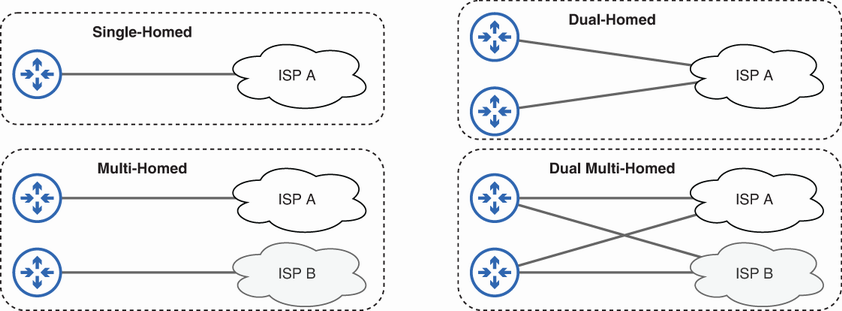
Compare single-homed, dual-homed, multi-homed, and dual multi-homed arrangements by connection count, ISP dependence, and redundancy. section 16.2.5
