A multi-homed design connects a network to two or more internet service providers, using one connection to each provider. If one ISP has problems, the network can continue operating through another connection. This design suits enterprises that need more resilience than a single ISP can provide. section 16.2.5 section 16.4
Compare internet connection designs by redundancy, cost, and complexity:
- Single-homed: one connection to one ISP; common in SOHO networks and provides no redundancy. section 16.2.5
- Dual-homed: two connections to one ISP; improves connection redundancy but remains vulnerable to an outage affecting that ISP. section 16.2.5 section 16.4
- Multi-homed: one connection to each of two or more ISPs; protects against problems affecting one provider. section 16.2.5
- Dual multi-homed: two connections to each of two or more ISPs; provides the highest redundancy but costs more and adds complexity. section 16.2.5 section 16.4
Figure 16.12 internet connection designs. Single-homed = one connection to one ISP. Dual-homed = two connections to one ISP. Multi-homed = one connection to each of two (or more) ISPs. Dual multi-homed = two connections to each of two (or more) ISPs.
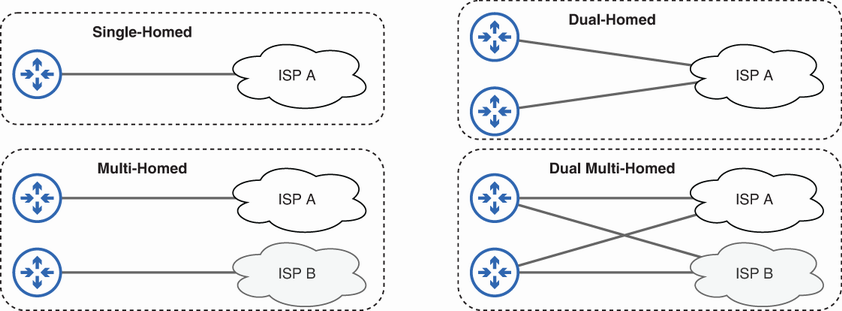
Compare the four connection patterns visually, from single-homed with no redundancy to dual multi-homed with the highest redundancy. section 16.2.5
