A single-homed design connects a network to the internet through one connection to one Internet service provider (ISP). It provides no connection redundancy and is common in SOHO networks, where a temporary outage may be inconvenient rather than catastrophic. section 16.2.5
Compare the main redundancy options:
- Dual-homed design: two connections to one ISP; it improves redundancy but remains vulnerable to ISP-wide problems. section 16.2.5
- Multi-homed design: one connection to each of two or more ISPs; it can continue operating when one ISP has problems. section 16.2.5
- Dual multi-homed design: two connections to each of two or more ISPs; it provides the highest redundancy at greater cost and complexity. section 16.2.5
Typical deployment
A home internet connection is probably single-homed: one router connection reaches one ISP. Adding another connection to that ISP creates a dual-homed design. section 16.2.5
Figure 16.12 internet connection designs. Single-homed = one connection to one ISP. Dual-homed = two connections to one ISP. Multi-homed = one connection to each of two (or more) ISPs. Dual multi-homed = two connections to each of two (or more) ISPs.
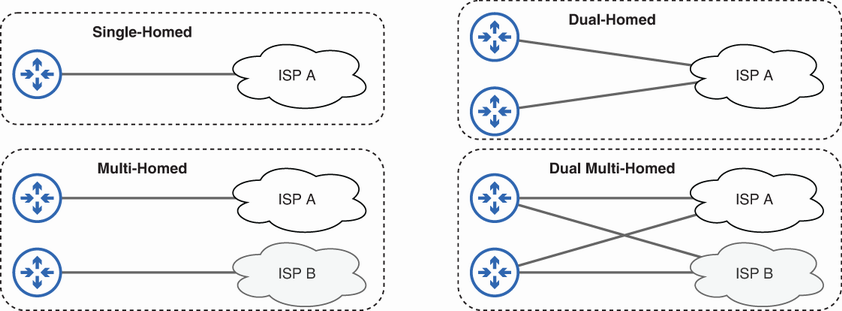
Compare single-homed, dual-homed, multi-homed, and dual multi-homed connection layouts. section 16.2.5
