Dynamic typing checks whether operations are valid while a program runs, rather than checking all code before it runs. Values such as numbers and strings carry type information that supports those runtime checks. Python, JavaScript, and MATLAB are dynamically typed; C, Java, and Fortran are examples of statically typed languages. section 1.1.1
The practical attraction is rapid experimentation. Suppose you load a large dataset, inspect a plot, and decide what calculation to try next. In an interactive workflow, you can change the code and inspect another result without restarting the program and reloading the data. Similar iteration helps when adjusting a game or a machine-learning model. section 1.3.1 section 1.3.2
Figure 1.1 In dynamically typed languages you can ping-pong between coding and observing. Large data sets do not need to be reloaded into memory.
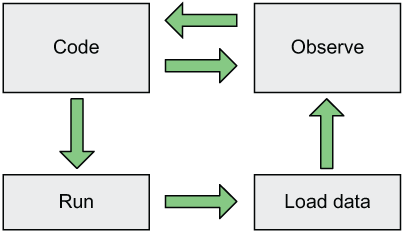
The figure shows the short loop between changing code and observing results while a large dataset remains loaded. section 1.3.1
Runtime flexibility often has a cost: boxed values can carry type and memory-management bookkeeping, and operations may need runtime field and type checks. The vector-scaling listings contrast a short Julia function with illustrative pseudocode for those checks; the pseudocode is an intuition aid, not an exact account of Julia's execution. section 18.4
Julia pairs dynamic typing with high performance. It was designed for just-in-time compilation and uses multiple dispatch for function calls. Fixed fields and enforced field types help its compiler generate optimized code; parametric types also matter for performance. This combination aims to avoid writing an interactive prototype in one language and rewriting it in another for speed. It does not make Julia ideal for every task: limited-memory embedded systems and typical systems programming remain poor fits. section 1.1.1 section 18.4 section 1.4 section 1.7





