An eigenvector, or eigenstate, of a quantum circuit transformation U is a state vector whose amplitudes are all multiplied by one corresponding eigenvalue when U is applied. The eigenvalue is a complex number with magnitude 1, so this operation can be viewed as rotating every amplitude by the eigenvalue’s phase. A circuit can have multiple eigenstates. section 9.2 section 9.7
Figure 9.11 The effect of a quantum circuit U when applied to one of its eigenstates

This diagram expresses the central invariant: applying U changes an eigenstate only by its eigenvalue factor, rather than changing its amplitude pattern. section 9.2
An eigenstate of RY(2θ)
A one-qubit circuit can prepare the state [i/√2, 1/√2] by applying X and then RX(−π/2). This state is an eigenstate of RY(2θ): applying RY(2θ) rotates both amplitudes by θ, giving eigenvalue cis(θ). With θ = π/6, RY(π/3) supplies the concrete rotation. Applying the gate twice accumulates the same phase rotation again. section 9.2
Eigenstates make a circuit’s otherwise hidden rotation phase usable in phase estimation:
- Prepare an eigenstate in the target register, while an estimation register begins the phase-encoding process. section 9.3
- Apply controlled powers of U; each application contributes the eigenvalue phase to a periodic state in the estimation register. section 9.3
- Apply the inverse QFT and estimate the encoded frequency to recover an estimate of the eigenvalue phase. section 9.3
This eigenstate-phase relationship also supports amplitude estimation. For a Grover operator, the two nontrivial eigenvalues have opposite phases, and their eigenstates place equal total probability on good and bad outcomes. If 2θ is one eigenphase, the probability of good outcomes is sin²θ. section 9.6.1
Figure 9.17 The QPE algorithm where U is an m-qubit circuit and E prepares an eigenstate of the circuit
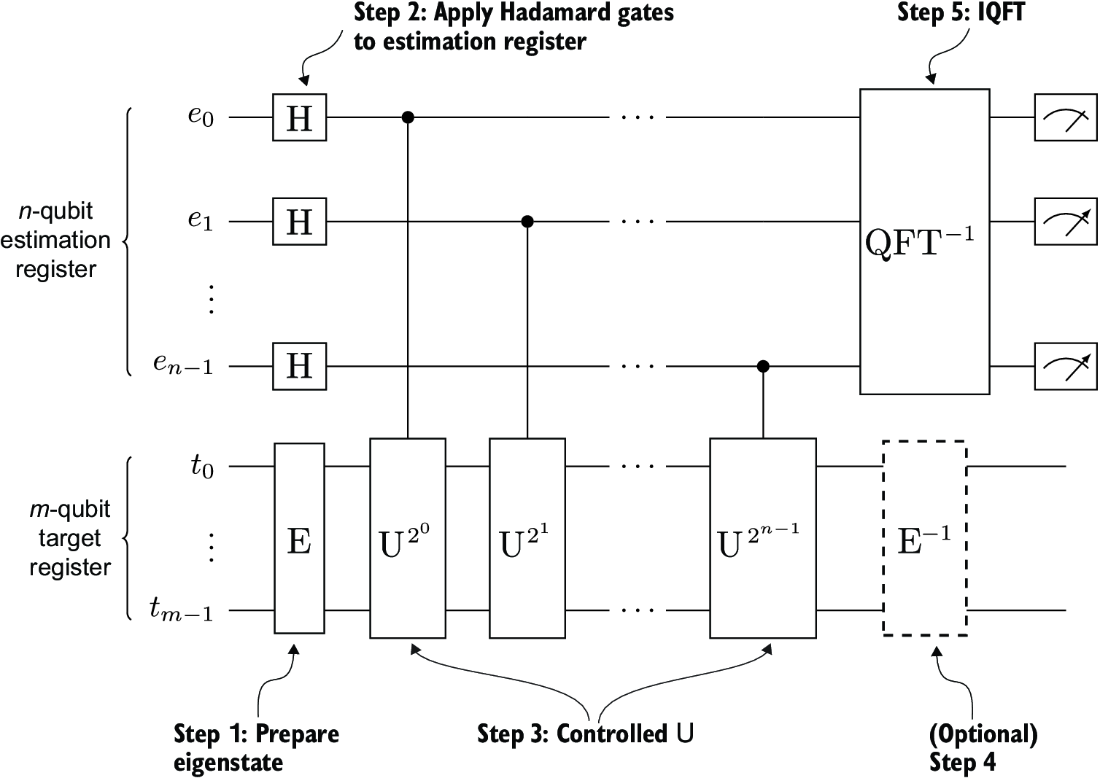
The circuit diagram shows where eigenstate preparation fits in QPE: a preparation circuit E initializes the target register before controlled applications of U encode its phase. section 9.3



