Elliptic curve cryptography (ECC) applies algebraic operations over elliptic curves to public-key cryptography. Its practical appeal is achieving comparable security with smaller numbers than RSA, reducing memory, processing, FPGA, and GPU costs. section 1.0 section 1.2
The cryptographic setting uses number theory, combinatorics, and finite fields. A curve over a finite field consists of points satisfying an elliptic-curve equation; algorithms establish relationships among those points, while sufficiently large fields and dimensions make those relationships difficult to recover. section 1.1 section 1.2
ECC supports several public-key cryptography tasks:
- Share secret keys during SSL/TLS handshakes. section 1.0
- Sign certificates for web-page authentication and HIPAA documents. section 1.0
- Enable aggregate digital signatures and shorter elliptic-curve zero-knowledge proofs. section 1.2
- Support blockchain ledgers, including healthcare and supply-chain applications. section 1.0
Why smaller numbers matter
RSA requires several-thousand-bit primes for standard security because its best-known attacks are subexponential. ECC can provide comparable security with smaller numbers, lowering system resource requirements. section 1.2
Figure 1.1 Conceptual elliptic curve over a finite field. Points are scattered in a multidimensional, astronomically large space.
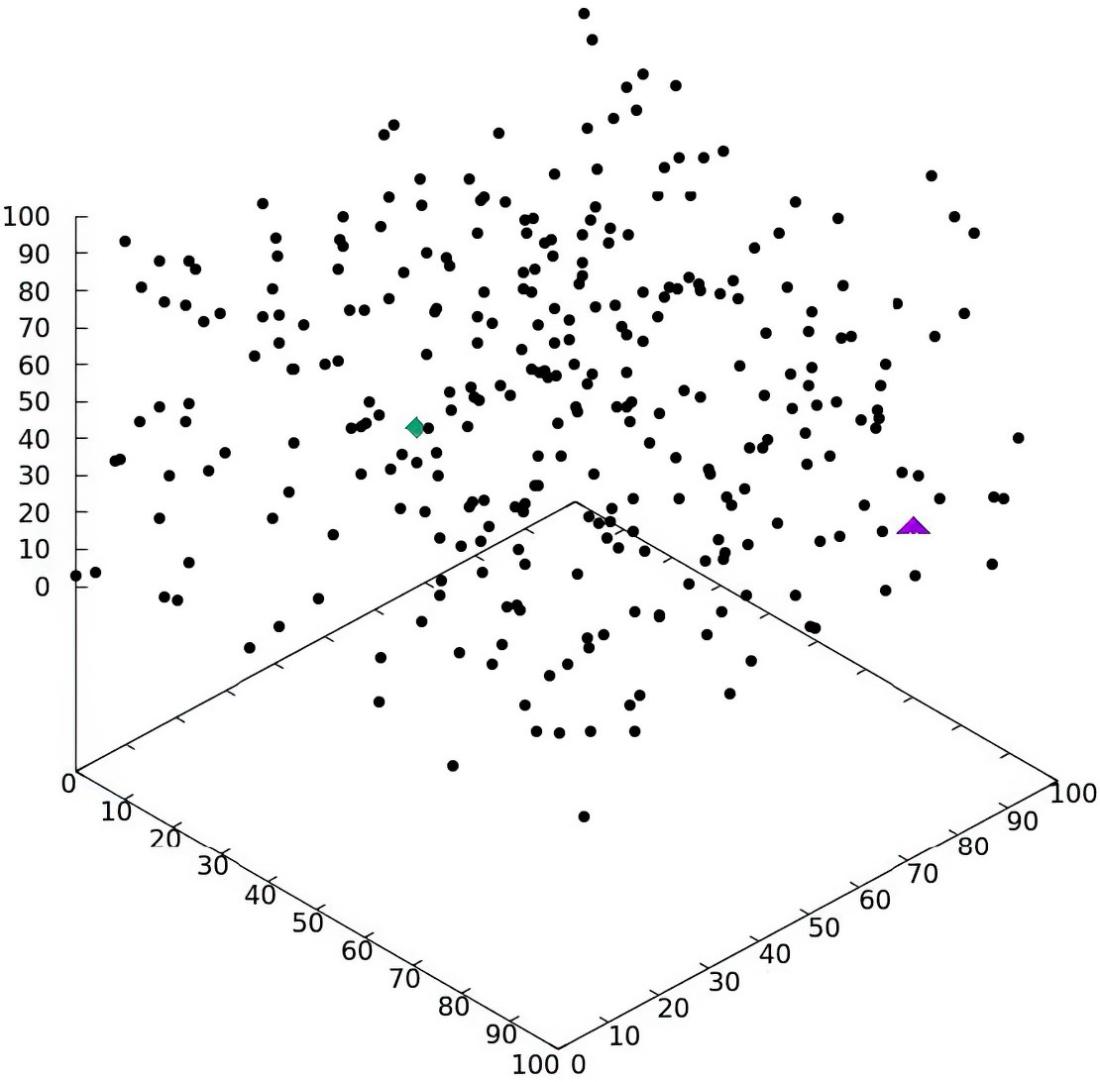
Visualizes a conceptual elliptic curve over a finite field, where scattered points satisfy the curve equation and participate in mathematical relationships. section 1.2