Elliptic curve cryptography builds public-key cryptography from groups formed by points on elliptic curves. Its practical appeal is smaller keys: about 256-bit parameters can provide an alternative to 2,048-bit Diffie-Hellman parameters. section 5.3
The underlying idea has three useful layers:
- Define a curve, commonly with the short Weierstrass equation y² = x³ + ax + b, subject to a non-degeneracy condition. section 5.3.1
- Treat curve points as an additive group, using geometric rules for point addition. section 5.3.1
- Run Diffie-Hellman over that group to obtain elliptic-curve Diffie-Hellman key exchange. section 5.3 section 5.3.1
- For two distinct points, draw their connecting line, find its third curve intersection, and reflect it; use a tangent for doubling and the point at infinity for cancellation cases. section 5.3.1
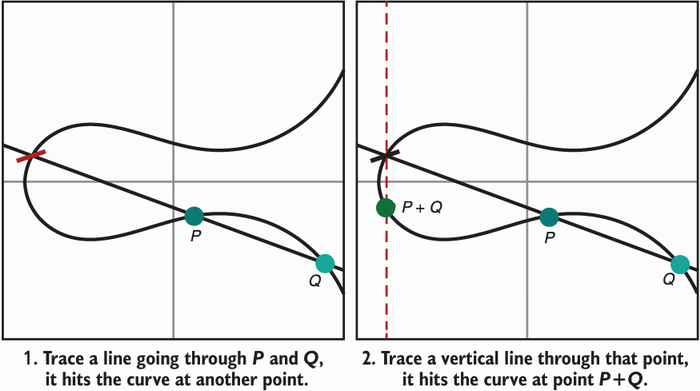
Visualize elliptic-curve point addition as a geometric construction. section 5.3.1
Figure 5.11 Elliptic curve cryptography (ECC), in practice, is mostly specified with elliptic curves in coordinates modulo a large prime number p. This means that what we use in cryptography looks much more like the right graph than the left graph.
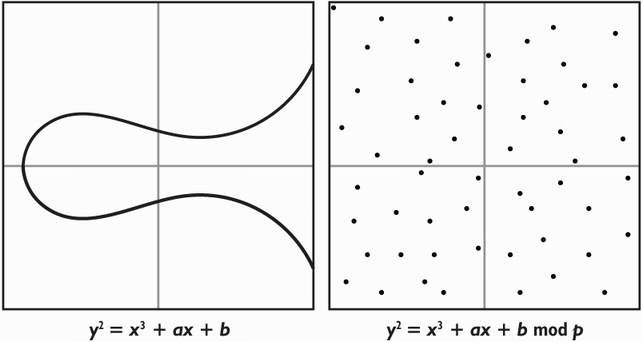
Compare ordinary curve geometry with cryptographic curves represented in coordinates modulo a large prime. section 5.3.1


