An elliptic-curve point is a coordinate pair satisfying an elliptic-curve equation over a chosen number system. For example, points can satisfy y² = x³ − 5x + 5. These points support algebraic operations such as addition and multiplication. section 3.1 section 3.0
Treat the following cases as part of the point representation and its operations:
- Add two points by drawing a line through them, taking the third curve intersection, and reflecting it across the curve. section 3.1
- Represent the identity with the point at infinity, written as 0; adding it leaves a point unchanged, while subtracting a point from itself produces it. section 3.1
- Use repeated point addition to define point multiplication, a central operation for finite-field elliptic-curve code. section 3.0 section 3.2
- Organize finite-field points into cyclic groups and subgroups whose sizes depend on the factors of the total point count. section 2.2
Signature verification checkpoint
A Schnorr verifier computes U = sB and V = ePₖ, adds them to obtain Qck, and accepts when both coordinates match the signature point Q. section 5.1.3
Figure 3.1 Elliptic curve \(y^2=x^3-5 x +5\)
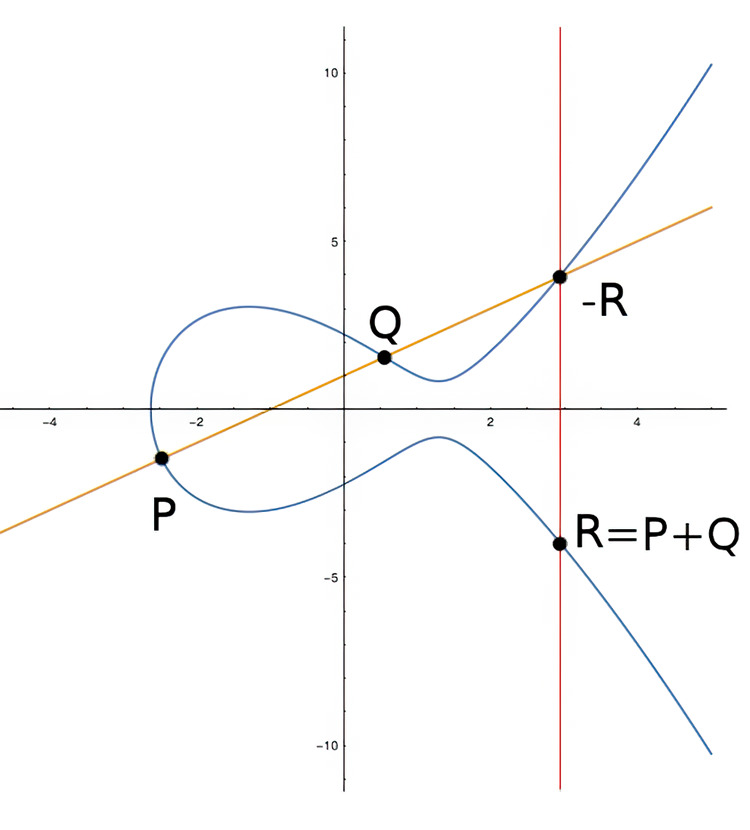
Visualize the real-number curve y² = x³ − 5x + 5 before transferring the same formulas to finite fields. section 3.1
Implementations store curve and point structures, handle the point at infinity explicitly, and provide routines for addition, multiplication, random-point generation, embedding, printing, and debugging. Polynomial extension curves use analogous point routines. section 3.2 section 13.2