Emulation lets embedded firmware run and be tested in software without the original hardware. It is useful early in development, when boards are unavailable or hardware setup problems make it difficult to isolate software faults. section 1.7.2 section 2.7
An emulator can support rapid iteration, remote collaboration, automated regression testing, and continuous integration. Starting without a physical board can also avoid problems such as incorrect cables, wiring, or missing host drivers. section 2.7.1 section 1.7.2
Tools offer different ways to work without a physical target:
- QEMU supports many ARM Cortex microcontrollers and can be used for software-level testing and validation. section 2.5.5
- Renode simulates a range of boards and peripherals with fine-grained configuration. section 2.5.5
- PICSimLab provides a graphical virtual-board environment; Wokwi provides web-based interactive prototyping and project sharing. section 1.7.2 section 2.5.5
Figure 1.7 PICSimLab virtual board
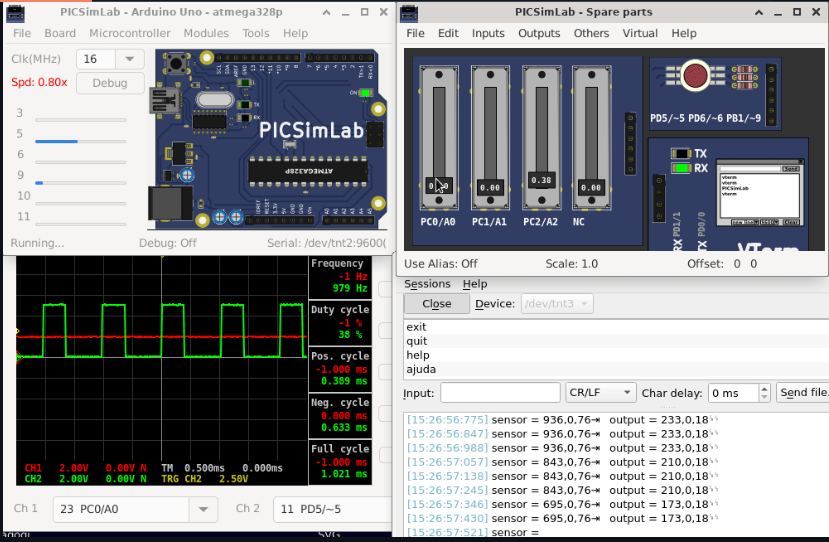
A PICSimLab virtual board illustrates a graphical alternative to working directly with physical hardware. section 1.7.2
Treat successful emulation as an early check, not final hardware validation. An emulator may omit peripherals or board-specific behavior and generally does not guarantee cycle-accurate timing. Test timing-sensitive behavior and peripheral details on the actual device. section 2.7.1

