An enabling team temporarily provides specialized expertise and guidance so other teams can build capabilities, adopt practices, and become more self-sufficient. Its purpose is upskilling and knowledge sharing, not creating a permanent dependency or waiting queue. section 3.1.1
An enabling team typically helps through:
- Training and workshops on practices such as DevOps, cloud migration, and security. section 10.3.2
- Consultation and hands-on support while teams adopt new technologies or overcome technical obstacles. section 10.3.2
- Standards, guidelines, documentation, and templates that help teams apply practices consistently. section 10.3.2
The boundary differs from both platform and complicated subsystem teams. Platform teams serve other stream-aligned teams through internal products, while complicated subsystem teams provide deep expertise in technically complex areas. Enabling teams instead work temporarily to transfer capability. section 3.1.1
Cloud migration assistance
During a cloud migration, a cloud-specialist enabling team helps stream-aligned teams understand cloud architecture, select appropriate services, and implement scalability and security practices. The engagement builds the teams’ capability rather than making the enabling team a permanent operator. section 10.3.2
Figure 3.1 The stream-aligned teams are domain-bounded, but so are the platform team and subsystem team. (Image taken from [1]. Used with permission.)
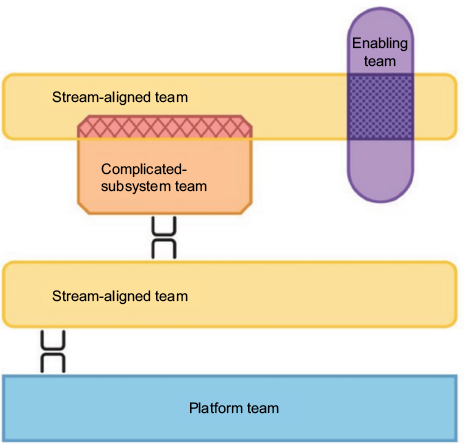
Use the team-topology diagram to place enabling teams alongside stream-aligned, platform, and subsystem teams and clarify their organizational boundaries. section 3.1.1

