A team type is an organizational pattern for assigning responsibilities and clarifying expected behavior in software delivery. Team Topologies defines four types: stream-aligned teams, platform groupings, complicated subsystem teams, and enabling teams. These patterns work best alongside the underlying principles rather than as labels applied in isolation. section 11.2 section 11.6
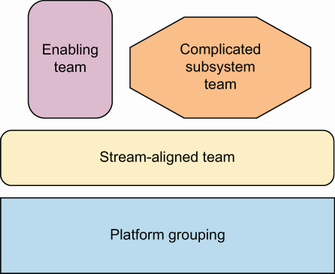
Use the four-team-types model to compare team responsibilities and identify where an existing team does not fit or carries too many diverse responsibilities. section 11.2.1
The four types distribute ownership and support across an organization:
- Stream-aligned teams own an independent value stream, combining business and IT responsibilities with the skills needed to discover, build, and run product capabilities. section 11.2.1
- Platform groupings provide shared capabilities that reduce stream-aligned teams’ cognitive load and improve their flow. section 11.6
- Complicated subsystem teams own complex system areas requiring specialist knowledge, while enabling teams support the growth of other teams. section 11.6
- Treat the model as aspirational: a team that appears to contain several types may have excessive or overly diverse responsibilities, and some areas may remain outside the model until modernized. section 11.2.1
Stream-aligned ownership
A stream-aligned team might own domain APIs, embedded software for hardware devices, a mobile or web application, or an end-to-end search feature spanning backend APIs and user-interface pages. section 11.2.1
Use team types to examine whether boundaries keep cognitive load manageable and whether responsibilities support independent value streams. Overlaying team boundaries on a Core Domain Chart can expose teams responsible for multiple highly complex subdomains. section 11.6
