liveBook · Manning

End-to-end learning

As explained in Optimization Algorithms: AI techniques for design, planning, and control problems

A learning approach that trains a model to map inputs directly to desired outputs with minimal separately engineered intermediate stages.

End-to-end learning trains a machine-learning model to formulate solutions directly from an input problem instance, rather than separately engineering every intermediate optimization stage. section 11.5 section 11.10

Within machine learning for combinatorial optimization, distinguish three roles:

  • End-to-end learning maps an input instance directly to a proposed solution. section 11.5
  • Learning to configure algorithms predicts parameters such as learning rates, annealing schedules, mutation variation, or pheromone influences. section 11.5
  • Machine learning combined with optimization repeatedly consults a model using the algorithm’s current state. section 11.5

Pointer networks for routing

A pointer network applies sequence-to-sequence learning with attention to variable-sized inputs. One example trains on m points and validates on n points for the Euclidean planar symmetric traveling-salesperson problem. section 11.5 section 11.10

Figure 11.14 Machine learning (ML) for combinatorial optimization (CO) problems
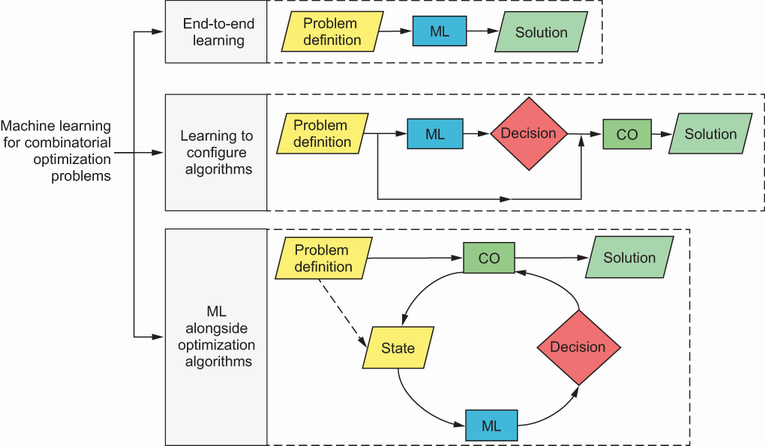
Use the comparison figure to distinguish direct solution formulation, learned algorithm configuration, and repeated model-guided optimization. section 11.5


How Optimization Algorithms: AI techniques for design, planning, and control problems covers it

How deep it goes
Defines direct formulation and contrasts two alternatives, but stops short of detailing training procedures or implementation.
Examples
Uses pointer networks trained and validated on differently sized Euclidean planar symmetric traveling-salesperson instances.
What you can do after
Evaluate direct solution formulation against learned algorithm configuration and repeatedly model-guided optimization.
How it connects
Connects machine learning with combinatorial optimization, sequence-to-sequence models, attention, and reinforcement learning.

Also explained in

Compare how 2 books explain end-to-end learning →

Related concepts

This explainer was generated by Manning's knowledge graph from the text of Optimization Algorithms: AI techniques for design, planning, and control problems. The section links point to the parts of the book it draws on.