An engine is an LLM-based system that delivers one bounded capability, such as summarization, search, or content generation. It receives a request, produces output, and stops; it does not choose later work or carry a task forward independently. section 1.1
Use an engine when a system needs a focused backend capability:
- A summarization engine condenses long passages into concise summaries for immediate return or later storage. section 1.1.1
- A Q&A engine answers questions against a knowledge base rather than relying only on the model’s training data. section 1.1.1
- Unlike a chatbot, an engine does not maintain conversational context; unlike an agent, it does not plan, select tools, or loop through multi-step work. section 1.1
A Q&A engine commonly separates ingestion from querying. During ingestion, it splits source text into chunks, converts them into embeddings, and stores the chunks and vectors in a vector store. During querying, it embeds the user’s question, retrieves semantically relevant chunks, combines them with the question in a prompt, and sends that context to the LLM. section 1.1.1
Figure 1.2 A Q&A engine implemented with RAG design. An LLM query engine stores domain-specific document information in a vector store. When an external system sends a query, it converts the natural language question into its embeddings (or vector) representation, retrieves the related documents from the vector store, and then gives the LLM the information it needs to craft a natural language response.
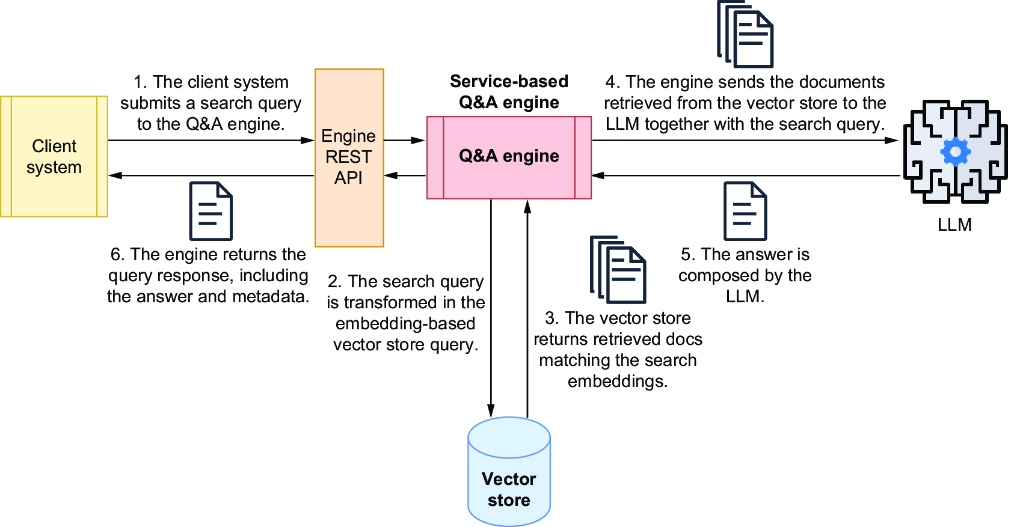
Trace a retrieval-augmented Q&A engine from an external question through embedding, vector-store retrieval, and response generation. section 1.1.1
