liveBook · Manning

Environment

As explained in Optimization Algorithms: AI techniques for design, planning, and control problems

An environment is the external set of conditions that interacts with an organism’s genotype to influence its characteristics.

In biology, an environment is the external set of conditions that interacts with an organism’s genotype to influence its phenotype: its observable physical, behavioral, and physiological characteristics. A genotype is a genetic blueprint, not a complete description of the traits that will be observed. section 7.2.1

From genes to observable traits

Imagine four genes associated with appetite, movement, feet, and skin covering. One combination might describe an insectivore with wings, flight, and feathers. These inherited values illustrate the genotype; the observable characteristics are the phenotype, which also reflects interaction with the environment. section 7.2.1

Figure 7.4 Genotype, phenotype, and taxonomic classification
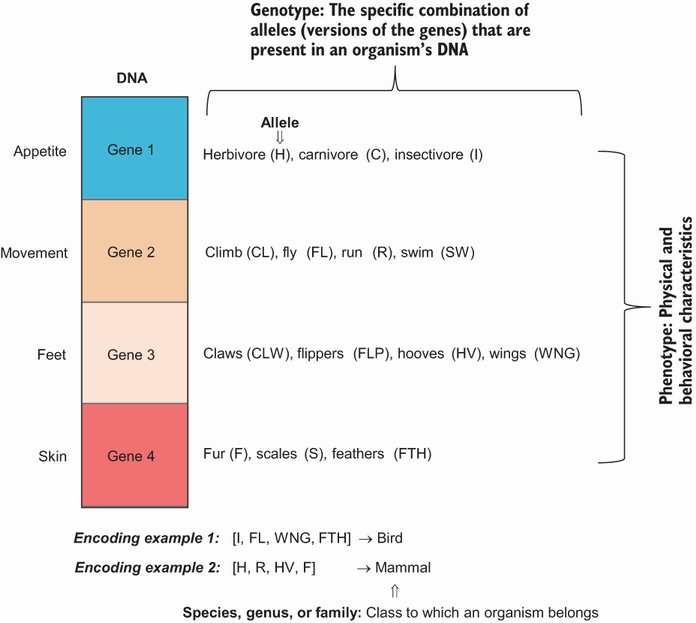
The figure connects a toy genotype with observable characteristics and classification. section 7.2.1

In reinforcement learning, *environment* has a different, operational meaning: the external world an agent acts in. An action can change its state, produce a reward, and affect later decisions. A model of that world may use deterministic effects or probabilities; for example, a commute by train can lead to an on-time arrival or a missed connection. The agent may observe the complete state or only part of it. section 12.1.1 section 12.1.2


How Optimization Algorithms: AI techniques for design, planning, and control problems covers it

How deep it goes
Defines genotype–environment interaction and elaborates reinforcement-learning environments through states, observations, actions, rewards, and transitions; does not model biological effects.
Examples
Uses a four-gene organism to illustrate genotype and phenotype and a commute to contrast certain and uncertain outcomes.
What it assumes
Introduces genotype and phenotype through a small example and defines states, observations, actions, and policies for reinforcement learning.
What you can do after
Evaluate/understand how phenotype relates to genotype and environment, and how an agent’s actions can change its environment.
How it connects
Connects genotype to phenotype in biology and links reinforcement-learning environments to Markov decision processes and partial observability.

Also explained in

Compare how 8 books explain environment →

Related concepts

This explainer was generated by Manning's knowledge graph from the text of Optimization Algorithms: AI techniques for design, planning, and control problems. The section links point to the parts of the book it draws on.





