liveBook · Manning

Estimator

As explained in Machine Learning Algorithms in Depth

An estimator is a rule that computes an approximation to an unknown statistical quantity from observed data or samples.

An estimator is a rule that uses observed samples to approximate an unknown statistical quantity. In importance sampling, weighted samples from a proposal distribution estimate expectations under a target distribution, even when normalization constants are unknown. section 2.7

Importance-sampling estimators are characterized by:

  • Weights formed from target-to-proposal density ratios, including ratios of unnormalized densities. section 2.7
  • Unbiasedness in theory under independent samples and consistency when importance-weight variance is finite. section 2.7
  • Variance and convergence assessed through the estimator’s weight behavior and Chebyshev’s inequality. section 2.7

Estimating an expectation

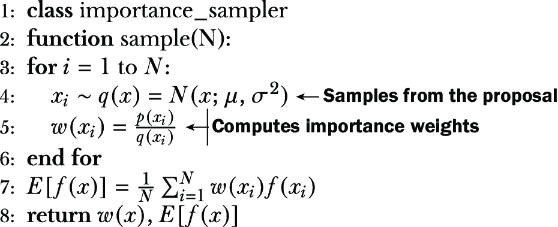
An importance sampler draws positive samples from a truncated Gaussian proposal, evaluates target and proposal densities, computes their ratio as a weight, and estimates the expectation of f(x)=2 sin((π/1.5)x). Numerical integration supplies a ground-truth comparison. section 2.7

Figure 2.15 Importance sampler pseudo-code
figure

Importance-sampler pseudocode makes the estimator’s sampling, weighting, and averaging procedure concrete. section 2.7


How Machine Learning Algorithms in Depth covers it

How deep it goes
Derives importance-sampling estimators, unbiasedness, variance, and consistency, stopping short of broader estimator theory.
Examples
Uses truncated Gaussian samples, density-ratio weights, a sinusoidal function, pseudocode, and numerical integration.
What it assumes
Assumes probability-density notation, sample independence for unbiasedness, and finite importance-weight variance for consistency.
What you can do after
Apply importance sampling to estimate expectations from normalized or unnormalized target and proposal distributions.
How it connects
Connects importance sampling with proposal distributions, normalization constants, the weak law of large numbers, and Chebyshev’s inequality.

Also explained in

Compare how 3 books explain estimator →

Related concepts

This explainer was generated by Manning's knowledge graph from the text of Machine Learning Algorithms in Depth. The section links point to the parts of the book it draws on.
