liveBook · Manning

Event

As explained in Microservices Patterns, Second Edition

A notification representing something notable that has occurred in an application.

An event is a notification that something notable has occurred, often as the result of an operation or a change to a domain object. section 3.1.1 section 8.3.1

Events serve several roles in application and service design:

  • Applications publish events to notify users or other applications about outcomes such as order creation, cancellation, or delivery. section 3.1.1
  • Events form part of a service API and can be consumed by other services. section 7.2.2
  • In CQRS, services publish events when data changes so a separate view can stay up to date. section 13.0
Figure 3.1 An application, such as FTGO, implements system operations - invoked by users, other applications, and the passing of time - and publishes events, which are the result of executing operations, and are subscribed to by other applications and users
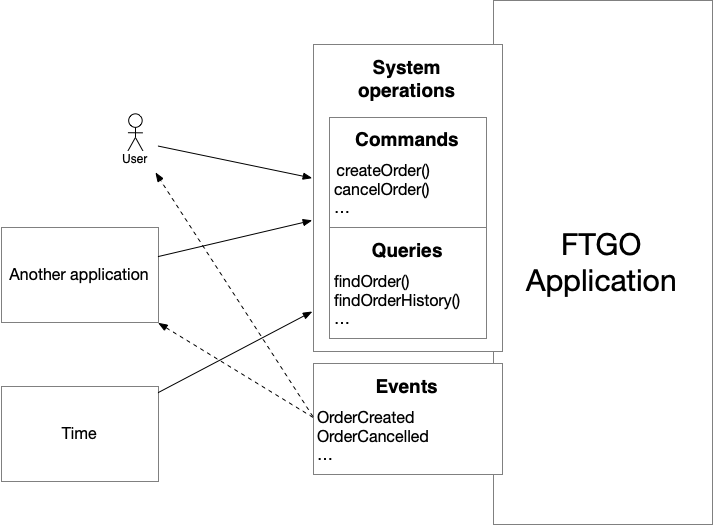
application as a black box

Shows how application operations produce events that users and other applications can receive. section 3.1.1


How Microservices Patterns, Second Edition covers it

How deep it goes
Defines events as messages about notable occurrences, often domain-object state changes, and distinguishes them from documents, commands, and replies.
Examples
Uses order creation, cancellation, and delivery notifications, and describes events that keep CQRS views current.
What you can do after
Understand how events communicate operation outcomes, form service APIs, and provide updates for CQRS views.
How it connects
Connects events to system operations, service APIs, domain events, message channels, publish-subscribe communication, and CQRS views.

Also explained in

Compare how 5 books explain event →

Related concepts

This explainer was generated by Manning's knowledge graph from the text of Microservices Patterns, Second Edition. The section links point to the parts of the book it draws on.


