Information that helps identify the location and cause of a software defect.
Evidence is information that narrows the search for a software defect’s location and cause. Gather it after triage, before isolating and reproducing the problem. section 11.3.1
Collect signals that reveal what happened and where to investigate:
Logging and error reports expose failures and relevant symptoms. section 11.3.1
Traces for relevant request paths show how a problem travels through the system. section 11.3.1
User bug reports add observed behavior from affected customers. section 11.3.1
Stern, kubectl, the Kubernetes dashboard, and observability software provide operational information. section 11.3.1
Call stacks and implicated code versions, branches, or tags connect failures to implementation changes. section 11.3.1
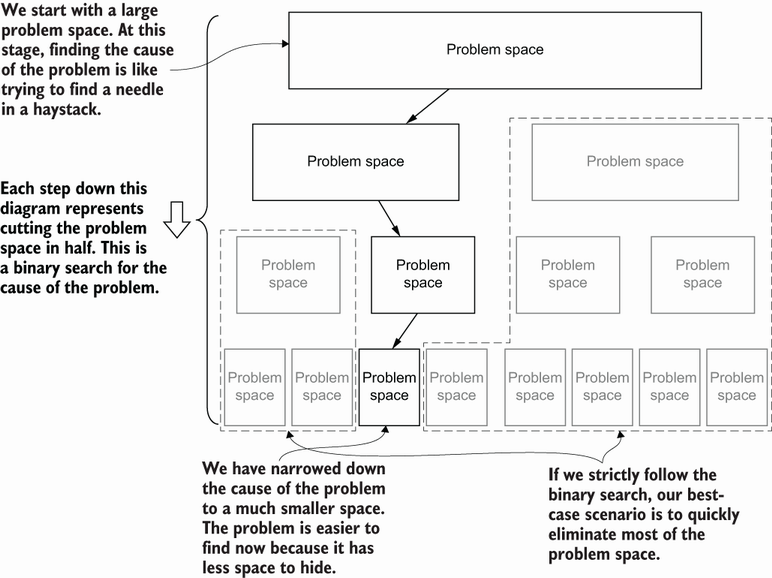
Figure 11.11 Cutting away the problem space until we isolate the exact source of the bug
Use the problem-space reduction view to connect gathered evidence with isolating the defect’s exact source. section 11.3.1
How Bootstrapping Microservices, Second Edition: With Docker, Kubernetes, GitHub Actions, and Terraform covers it
How deep it goes
Defines evidence, lists operational sources, and stops short of prescribing a fixed collection procedure.
Examples
Uses logs, error reports, request traces, user reports, Kubernetes tooling, call stacks, and code version metadata.
What it assumes
Assumes an existing debugging workflow and familiarity with application and operational diagnostic signals.
What you can do after
Diagnose/debug with it by narrowing investigation toward the real defect location.
How it connects
Connects evidence with debugging, triage, observability, logging, tracing, call stacks, and problem isolation.
dry runproduced by · A dry run is an execution mode that previews, validates, or reports an operation’s prospective behavior without carrying out the effects being previewed.
bayesian statisticsused by · A framework for statistical inference that represents uncertainty with probability distributions and updates prior distributions using observed evidence and a likelihood model to obtain posterior distributions.
monitoringproduced by · Monitoring is the ongoing systematic observation and measurement of a system's behavior, condition, or outcomes to assess operation and detect changes or problems.
experimentationproduced by · Experimentation is the planned investigation of a question or hypothesis by conducting trials or interventions and observing their outcomes.
Bayes' theoremuses · Bayes' theorem relates conditional probabilities, expressing a posterior probability in terms of a prior probability, a likelihood, and the evidence.
corepart of · A blog-post optimization group concerned with focus, logical organization, and adequate technical support.
This explainer was generated by Manning's knowledge graph from the text of Bootstrapping Microservices, Second Edition: With Docker, Kubernetes, GitHub Actions, and Terraform. The section links point to the parts of the book it draws on.