Evolutionary computation (EC) is a family of search methods inspired by biological evolution. Instead of improving one candidate solution at a time, it works with a population of candidates and repeatedly produces and selects new ones. Genetic algorithms, differential evolution, genetic programming, evolutionary programming, evolutionary strategies, cultural algorithms, and co-evolution belong to this family. section 7.2.3 section 7.1
A search-team analogy
Imagine several people searching for treasure. Keep the better-performing searchers, replace others with new recruits, and continue searching. That captures the selection intuition: promising candidates influence the next generation. It is an analogy, not a substitute for defining how candidate solutions and their quality are measured. section 7.0 section 7.2.3
A typical evolutionary search repeats these operations:
- Create an initial population of candidate solutions, randomly or with a heuristic. section 7.2.3
- Evaluate each candidate with a fitness function and select promising parents. section 7.2.3
- Create offspring through crossover, which combines parent traits, and mutation, which introduces random changes. Evaluate the population and continue through multiple generations. section 7.2.3 section 7.2.2
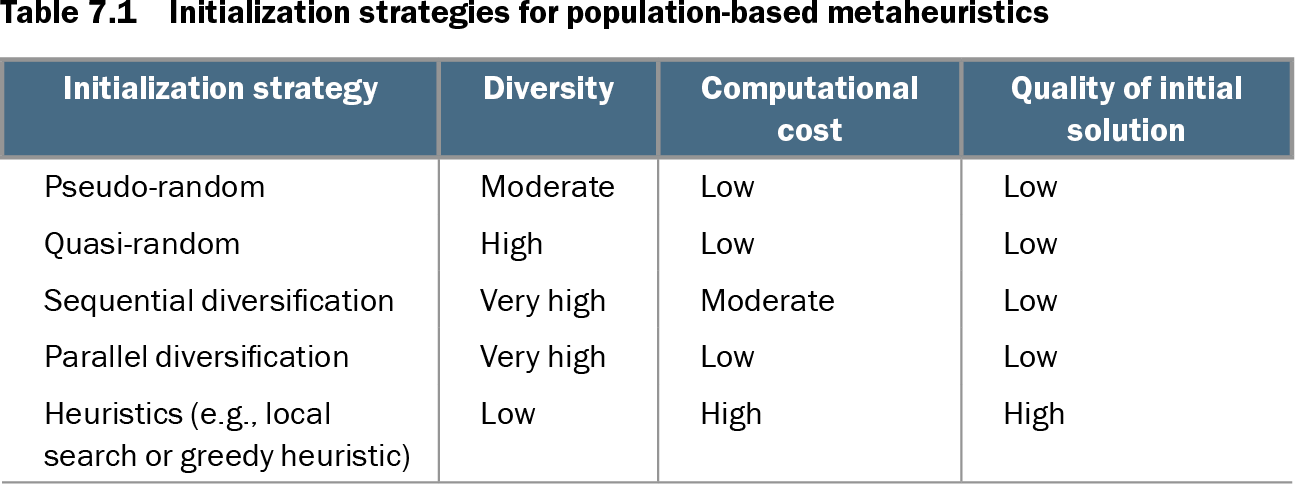
Population size is a practical choice, not a universal constant: problem complexity, variable count, accuracy needs, and computing resources all matter. Initialization also trades off diversity, cost, and initial solution quality. Genetic algorithms use crossover and mutation to balance exploring new areas against refining existing solutions; too little diversity risks premature convergence. Unlike evolutionary computation, swarm intelligence draws on the collective behavior of social organisms. section 7.2.3 section 7.5 section 7.1
Table 7.1 Initialization strategies for population-based metaheuristics (view table figure)
| Initialization strategy |
Diversity |
Computational cost |
Quality of initial solution |
|---|---|---|---|
| Pseudo-random |
Moderate |
Low |
Low |
| Quasi-random |
High |
Low |
Low |
| Sequential diversification |
Very high |
Moderate |
Low |
| Parallel diversification |
Very high |
Low |
Low |
| Heuristics (e.g., local search or greedy heuristic) |
Low |
High |
High |
Compare population-initialization strategies by diversity, computational cost, and initial solution quality before choosing one to test. section 7.1