liveBook · Manning

Expectation

As explained in Think Like a CTO

An expectation is a clearly communicated standard about how an interaction, responsibility, or situation should proceed.

An expectation is a clearly communicated standard for how an interaction, responsibility, or situation should proceed. Effective expectations make availability, performance, communication, and success easier to understand without turning management into constant supervision. section 6.7.3 section 7.4.2

Make expectations specific enough to guide behavior while leaving room for organizational context and individual circumstances:

  • Define how people should request attention: invite questions, but move substantial conversations to a scheduled time so focused attention is possible. section 6.7.3
  • Describe what success looks like for each role and competency in one or two sentences, using language that supports concrete review examples. section 7.1.2
  • Set remote-work norms for core hours, availability, absence signals, and check-ins without treating employees as continuously available. section 7.4.2
  • Review and refine definitions as the team grows so decisions remain clear and demonstrably tied to performance rather than subjective judgment. section 7.1.2

A practical availability agreement

A manager welcomes a team member who wants to talk, quickly determines whether the question needs more than a brief answer, and schedules time when it does. For a remote team, the manager also establishes core hours and asks people to signal breaks or other periods away from their desks. The result is genuine accessibility without continual interruption or an assumption of instant availability. section 6.7.3 section 7.4.2

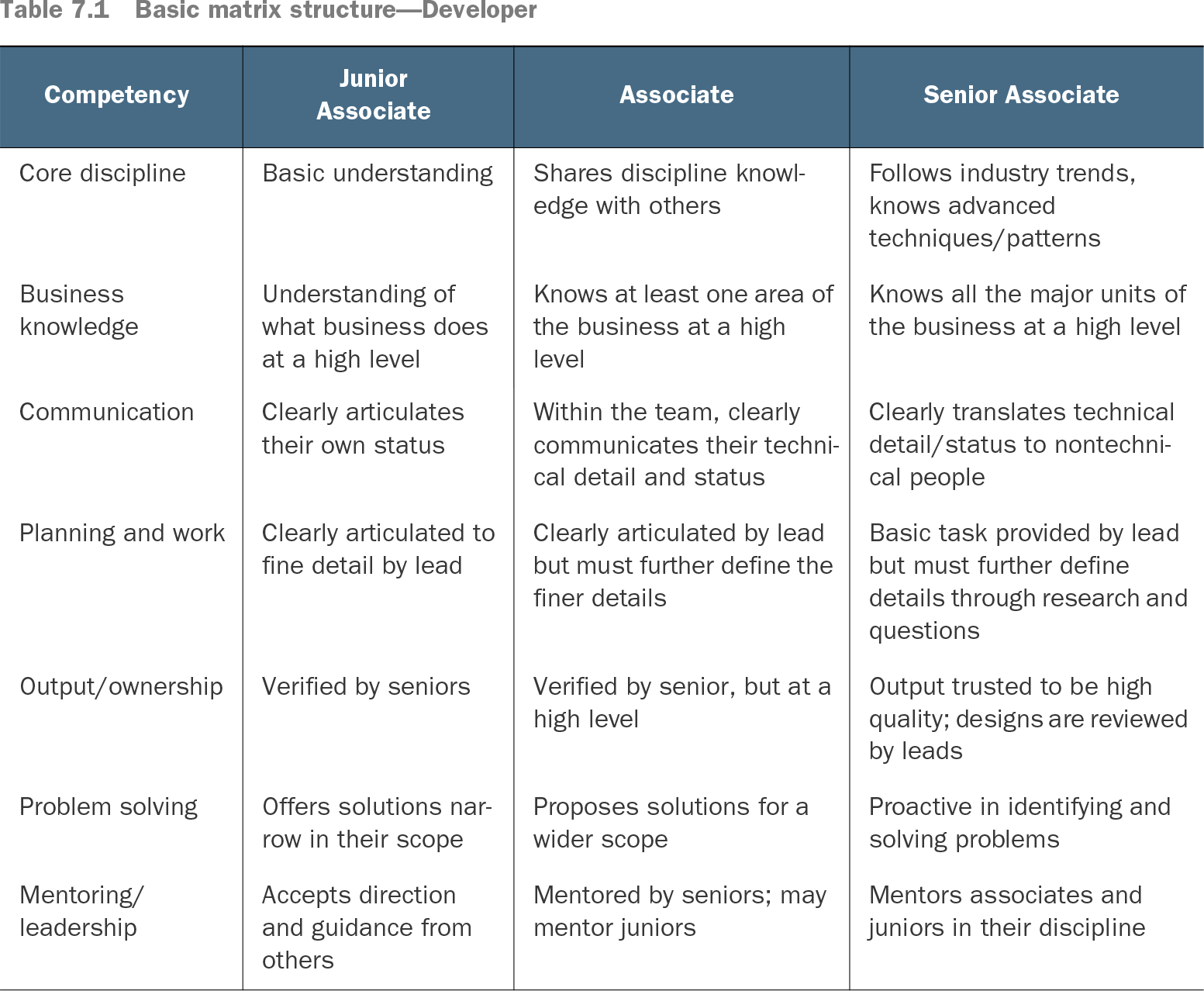
Table 7.1 Basic matrix structure—Developer (view table figure)

Competency

Junior Associate

Associate

Senior Associate

Core discipline

Basic understanding

Shares discipline knowledge with others

Follows industry trends, knows advanced techniques/patterns

Business knowledge

Understanding of what business does at a high level

Knows at least one area of the business at a high level

Knows all the major units of the business at a high level

Communication

Clearly articulates their own status

Within the team, clearly communicates their technical detail and status

Clearly translates technical detail/status to nontechnical people

Planning and work

Clearly articulated to fine detail by lead

Clearly articulated by lead but must further define the finer details

Basic task provided by lead but must further define details through research and questions

Output/ownership

Verified by seniors

Verified by senior, but at a high level

Output trusted to be high quality; designs are reviewed by leads

Problem solving

Offers solutions narrow in their scope

Proposes solutions for a wider scope

Proactive in identifying and solving problems

Mentoring/leadership

Accepts direction and guidance from others

Mentored by seniors; may mentor juniors

Mentors associates and juniors in their discipline

Use the developer competency matrix to compare expectation levels across discipline, business knowledge, communication, planning, and ownership. section 7.1.2


How Think Like a CTO covers it

How deep it goes
Provides practical scheduling, competency-definition, and remote-work procedures while stopping short of universal rules.
Examples
Uses scheduled conversations, core-hour agreements, absence signals, and developer competency-level descriptions.
What it assumes
Assumes responsibility for managing people and introduces clarity through communication, review criteria, and operating agreements.
What you can do after
Apply clear standards to schedule attention, define role success, and coordinate remote-team availability.
How it connects
Connects feedback, annual reviews, competency matrices, communication, and remote work.

Also explained in

Compare how 5 books explain expectation →

Related concepts

This explainer was generated by Manning's knowledge graph from the text of Think Like a CTO. The section links point to the parts of the book it draws on.