Experiment tracking turns trial-and-error into inspectable science by recording tests and results in a shared, searchable system rather than leaving findings in private notebooks. section 3.4.2
Its practical value appears when a production model fails: teams can investigate the original experiment, compare alternatives, and avoid repeating the same mistakes. Trackers sit alongside model registries, feature stores, pipelines, and monitoring in an MLOps platform. section 3.4 section 3.4.2
A useful tracker should support:
- Searchable records of tests and results that others can inspect, not merely manually maintained notebook notes. section 3.4.2
- Links from fine-tuning runs to the starting model checkpoint and, where possible, the original training experiment and data. section 3.4.2
- Evaluation-metric tooling suited to language models, where several metrics may matter simultaneously. section 3.4.2
- Integration with a model registry, since model metadata usually belongs with experiment records and later model versions need operational traceability. section 3.4.3
Choosing a tracker
MLflow is a prominent open-source option with a hosting solution; CometML and Weights & Biases are paid alternatives. Selection matters less than using the system consistently and adapting it for fine-tuning rather than assuming every run trains a model from scratch. section 3.4.2
Figure 3.7 A high level view of an MLOps infrastructure with LLMs in mind. This diagram attempts to cover the full picture and the complexity of the many tools involved to make ML models work in production.
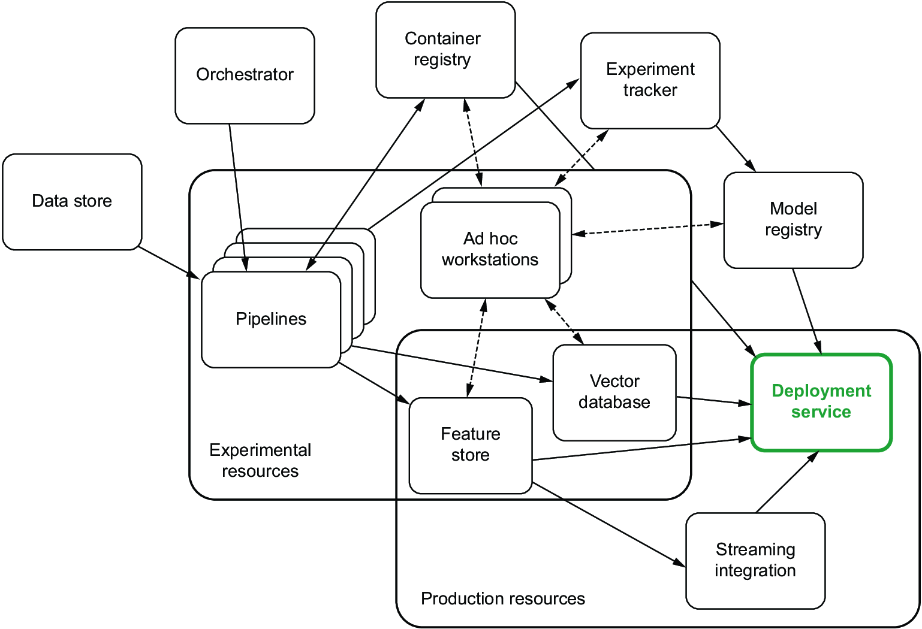
Use the infrastructure view to locate experiment tracking among the surrounding MLOps, DataOps, DevOps, and LLM production components. section 3.4




