Experiment tracking organizes model development by recording training configurations, run metrics, validation results, and system-resource measurements. It makes runs easier to analyze, compare, report, and share with a team. section 8.2.1
A practical tracking workflow supports several decisions:
- Record hyperparameters and training or validation metrics for every run, including values such as loss and accuracy. section 8.2.1
- Monitor GPU memory and utilization to assess resource requirements, choose cost-effective hardware, and estimate training or inference costs. section 8.2.1
- Use dashboards, reports, parallel-coordinate plots, and tabular run views to compare hyperparameter combinations and model performance. section 8.2.1
- Connect tracking with hyperparameter sweeps to search combinations systematically and identify the best-performing model. section 8.2.1
A W&B sweep configuration
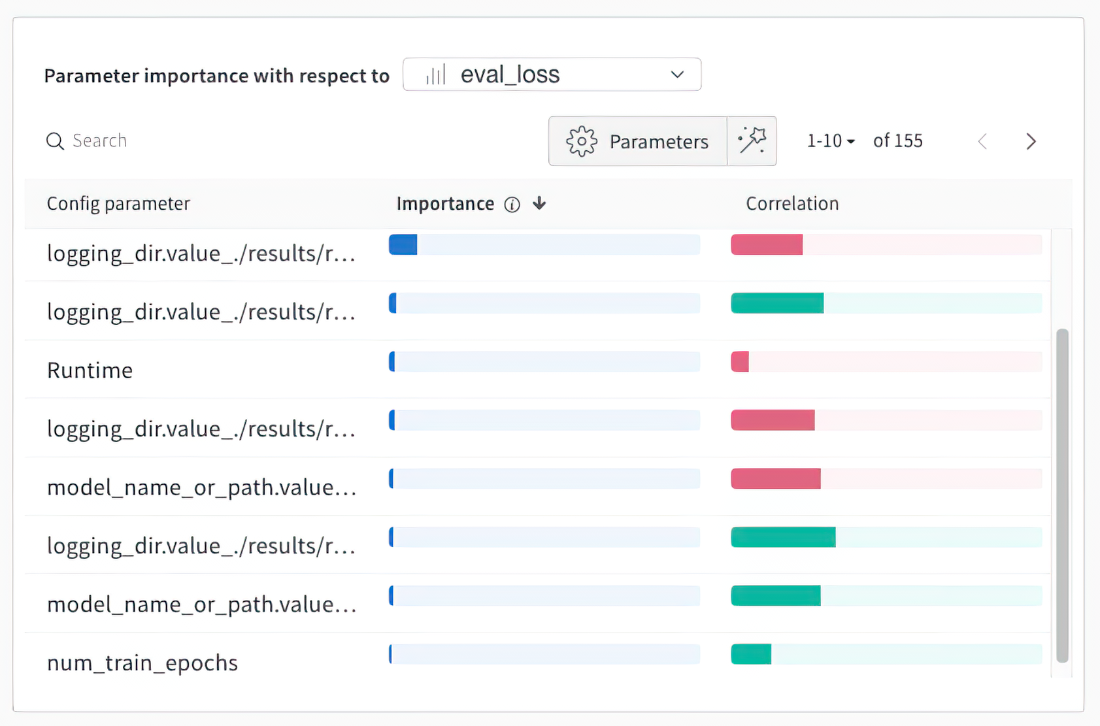
Define a sweep with Bayesian search, minimize eval_loss, vary learning rate, epochs, batch size, and model name, then enable Hyperband early termination. Start it with wandb.sweep(sweep_config, project="huggingface_sweeps"). section 8.2.1
Figure 8.6 A tabular view of all the runs in the sweep, where you can sort and filter based on different metrics and hyperparameters
A tabular run view supports sorting and filtering experiments by metrics and hyperparameters. section 8.2.1




