Suppose a recommender learns that you respond to dog videos. It can keep showing familiar successes (exploitation) or try unfamiliar items (exploration) to uncover interests that have not surfaced. section 4.2
Familiar picks can deliver short-term value yet miss broader interests; distant experiments can feel irrelevant and push users away. The balance depends on each user’s tolerance for discovery. section 4.2
Because preferences are inferred from interactions, observed behavior may not capture every interest; treating it as a complete map raises a construct-validity question. section 4.2
Figure 4.1 Recommender systems learn our preferences by observing our interactions with the items they present. There is no guarantee that all the preferences will be appropriately accounted for. In this figure, the user is a book lover, but the system is unaware of their preferences, and it’s reinforcing the known ones.
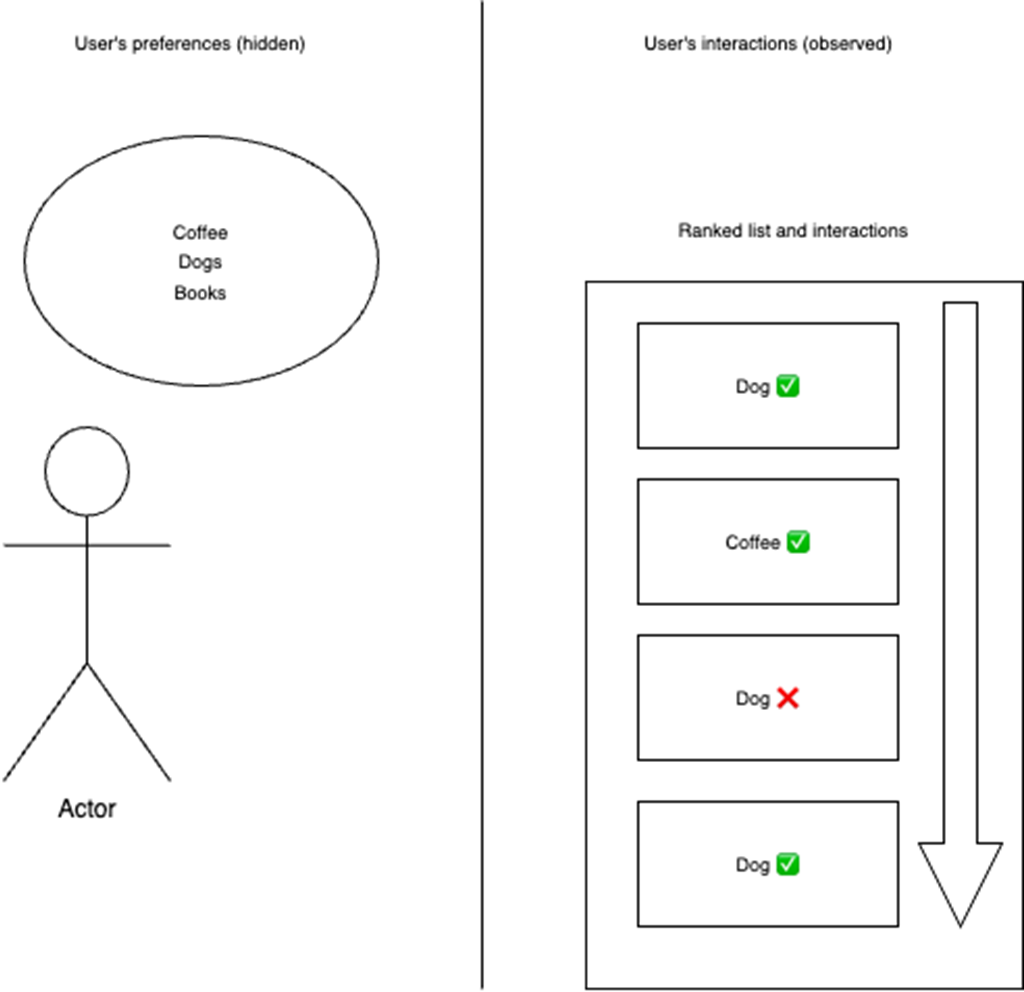
The illustration shows a recommender reinforcing known interests while missing the user’s love of books. section 4.2





