liveBook · Manning

Exponential growth pattern

As explained in 100 SQL Server Mistakes and How to Avoid Them

An exponential growth pattern is a growth model in which an amount increases by a constant proportion or multiplier over equal time intervals.

An exponential growth pattern increases by a changing amount over equal intervals; monthly doubling produces a steep “dog-leg curve” and can exhaust planned storage rapidly. section 9.6

Use the pattern to avoid underestimating capacity:

  • Compare projected growth with a linear baseline, such as data files consuming 5 GB per day. section 9.6
  • For existing systems, chart historical data points and project storage requirements forward. section 9.6
  • For greenfield systems, translate business forecasts into database volumes before installing additional SAN capacity. section 9.6

Sales database forecast

A forecast of 5,000 customers placing an average of 10 orders each can be expanded into representative database data using CROSS JOINs and numbers tables. section 9.6

Figure 9.6 Exponential growth pattern
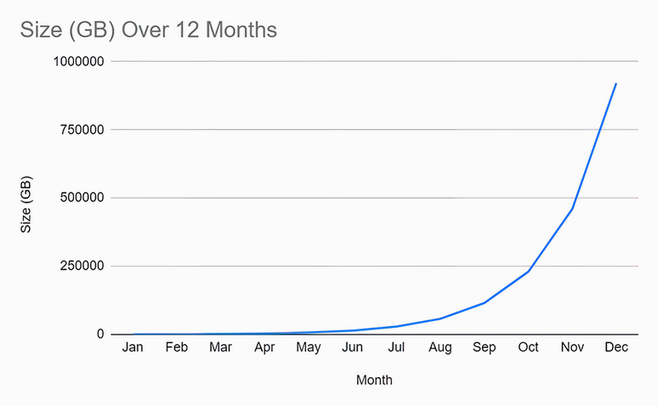
The figure makes the steep, nonlinear storage trajectory visible beside the flatter linear pattern. section 9.6

How 100 SQL Server Mistakes and How to Avoid Them covers it

How deep it goes
Contrasts monthly doubling with flat daily consumption and applies forecasting, but does not develop exponential-growth mathematics.
Examples
Uses a sales database forecast of 5,000 customers averaging 10 orders each to demonstrate data expansion.
What it assumes
Assumes historical measurements or business projections; greenfield planning begins by eliciting forecasts from application owners.
What you can do after
Apply it to estimate storage and generate forecast-aligned database data with CROSS JOINs and numbers tables.
How it connects
Connects exponential growth with capacity planning, data files, SAN capacity, historical data, and business forecasting.

Related concepts

This explainer was generated by Manning's knowledge graph from the text of 100 SQL Server Mistakes and How to Avoid Them. The section links point to the parts of the book it draws on.