liveBook · Manning

Linear growth pattern

As explained in 100 SQL Server Mistakes and How to Avoid Them

Linear growth is a growth pattern in which an amount increases by approximately the same quantity over equal intervals.

A linear growth pattern increases an amount by roughly the same quantity over equal intervals. In database capacity planning, a system consuming about 5 GB of data each day follows this pattern. Treating growth as an afterthought can cause unplanned expenditure, storage delays, and prolonged downtime while new SAN capacity is installed. section 9.6 section 9.12

Do not confuse linear growth with exponential growth. A workload that doubles every month follows an exponential, “dog-leg” curve and can outgrow a projection based on a flat daily rate. section 9.6

Use the growth pattern to choose a capacity-planning approach:

  • For an established system, chart historical data points and project them forward. section 9.6
  • For a new application without historical data, assess expected business growth with the application owner. section 9.6
  • Test a new sales database by modeling customers, delivery addresses, and sales orders from expected business averages. section 9.6
Figure 9.5 Linear growth pattern
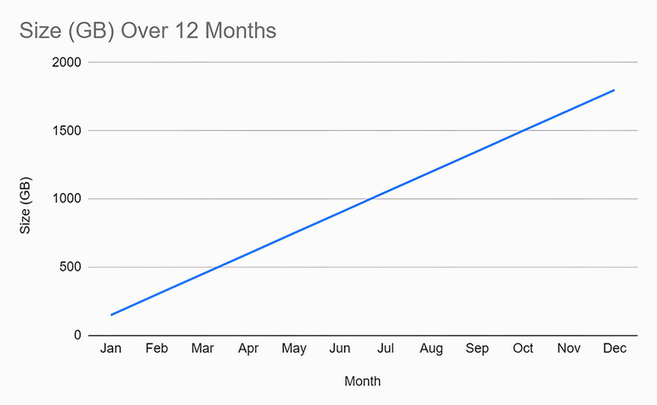
Use the figure to recognize the steady slope associated with linear growth before comparing it with an exponential curve. section 9.6

How 100 SQL Server Mistakes and How to Avoid Them covers it

How deep it goes
Explains the pattern, contrasts it with exponential growth, and gives projection and modeling procedures without detailing forecasting formulas.
Examples
Uses 5 GB of daily data consumption, monthly doubling, and a modeled sales database with customers and orders.
What it assumes
Assumes basic database-storage planning and teaches the distinction between historical projection and business-based estimation.
What you can do after
Apply capacity projections by charting historical usage or modeling expected business growth for a new application.
How it connects
Connects linear growth with capacity planning, exponential growth, data files, historical data, and greenfield applications.

Related concepts

This explainer was generated by Manning's knowledge graph from the text of 100 SQL Server Mistakes and How to Avoid Them. The section links point to the parts of the book it draws on.