An external factor is a demand driver outside a company’s control. It helps explain why demand changes beyond the effects of decisions such as pricing, promotions, marketing, events, shortages, or substitution products. Common external factors include holidays, weather, macroeconomic indicators, competition, online visibility such as search volume, and legal or regulatory conditions. section 14.2.1
The practical question is not simply whether a factor affects demand, but whether it can support a forecast at the required horizon. Assess its likely impact, the availability of historical data, and the availability of future data. Historical weather may be available, for example, while weather information may be unsuitable for forecasting demand six months ahead. section 14.2.1
Use external factors as part of a demand-planning data decision:
- Start with the decision the forecast must support, then define the needed horizon and granularity. section 1.3
- Collect unconstrained demand rather than constrained sales, alongside data for external drivers that affect demand. section 1.2.2
- Separate drivers the company controls from those it does not, so that planned actions are not confused with outside conditions. section 14.2.1
- Prioritize factors whose past records and future values are accessible enough for the planning horizon. section 14.2.1
- Judge the resulting forecast by usefulness for the decision, not by accuracy alone. section 1.3
Choosing a factor for a six-month forecast
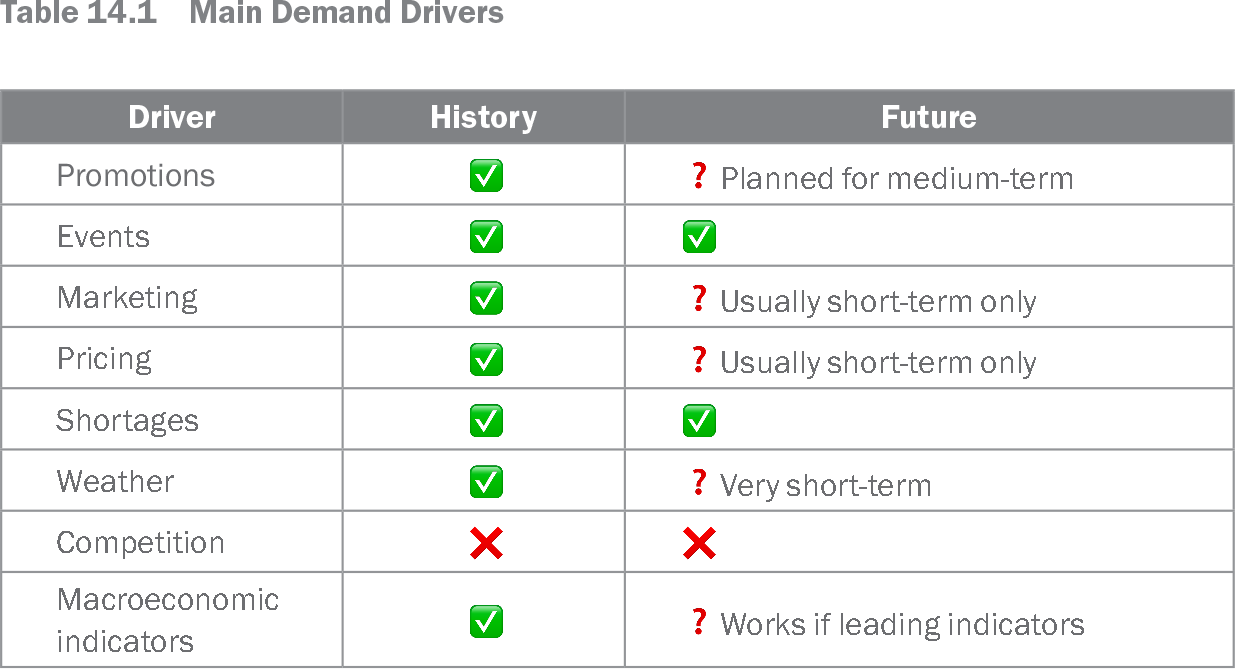
A planner may observe that weather affects demand, yet reject it as a six-month forecasting input if future weather information is unavailable at that horizon. A macroeconomic indicator may be more usable when it acts as a leading indicator, while competition can be difficult to use when neither historical nor future information is accessible. section 14.2.1
Table 14.1 Main Demand Drivers (view table figure)
| Driver |
History |
Future |
|---|---|---|
| Promotions |
✅ |
❓ Planned for medium-term |
| Events |
✅ |
✅ |
| Marketing |
✅ |
❓ Usually short-term only |
| Pricing |
✅ |
❓ Usually short-term only |
| Shortages |
✅ |
✅ |
| Weather |
✅ |
❓ Very short-term |
| Competition |
❌ |
❌ |
| Macroeconomic indicators |
✅ |
❓ Works if leading indicators |
Compare demand drivers by whether historical data exists and whether future values can be obtained; this determines which factors can serve a given forecast horizon. section 14.2.1
External-factor data supports a stronger forecast baseline and can reduce reliance on manual adjustments. It does not make a forecast automatically useful: the forecast must still fit the decision, use appropriate demand data, and be reviewed at the relevant short-, mid-, or long-term horizon. section 1.3