Fast flow is a style of software delivery in which teams continuously release small changes and rapidly receive feedback from users and production on each one. It helps an organization respond to change, experiment, and learn without relying on infrequent, large releases. section 1.1 section 1.1.2
Fast flow needs more than pressure to work faster. It combines DevOps practices, an organization structured around Team Topologies, and an architecture that supports both. Changes flow toward production; feedback flows back to development; experimentation and learning improve the next change. section 1.0 section 1.1.3
Figure 1.3 Fast flow requires a combination of three elements: DevOps as the development process, an organization structured using the Team Topologies patterns, and an architecture that enables DevOps and Team Topologies.
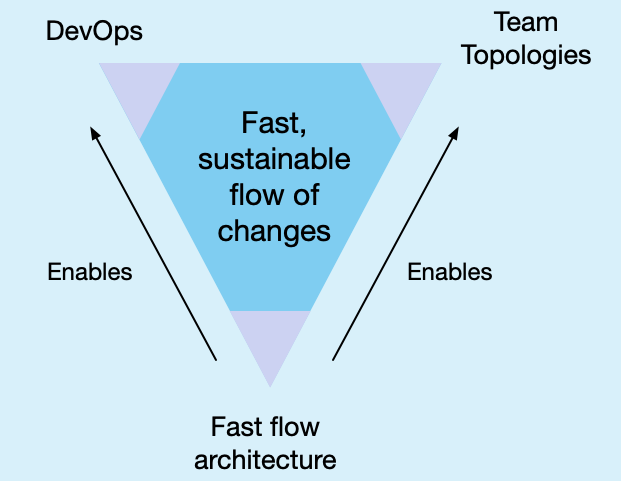
The success triangle relates the development process, team structure, and enabling architecture. section 1.1.3
Measure delivery performance using the four DORA metrics:
- Lead time: time from code commit to running in production. section 1.1.2
- Deployment frequency: how often changes reach production. section 1.1.2
- Change failure rate: the percentage of changes that fail in production. section 1.1.2
- Failed deployment recovery time: time needed to restore service after a failure. section 1.1.2
Speed and reliability are both important: frequent delivery accelerates learning, while failure and recovery metrics reveal operational consequences. Teams need enough autonomy to implement and deploy changes without routinely coordinating with other teams, supported by loose design-time coupling and a fast, automated deployment pipeline. section 1.1.2 section 1.2.1
Evaluate the architecture against five qualities:
- Modifiability: make application changes easily, aided by cohesive, loosely coupled design. section 5.7
- Evolvability: upgrade the technology stack easily, potentially one component at a time. section 5.7
- Testability: quickly verify that a change is releasable. section 5.0
- Deployability: deploy quickly and reliably, with automation and rollback when needed. section 5.7
- Observability: understand runtime and user behavior to keep deployments safe and obtain feedback. section 5.7
Independent service changes
In a microservice architecture, an Orders team can change its service without regularly coordinating with other teams. If its build breaks, other teams can still deploy. Each service has a dedicated pipeline handling a smaller codebase, reducing the work needed to test and deploy a change. These benefits depend on maintaining loose coupling between services. section 1.3.2 section 7.4.1
Choose architecture to solve the actual delivery constraint. A monolith can support fast flow, especially for a new application; starting with one also makes it easier to revise boundaries while the domain is still unclear. For a large application and organization, a monolith may create coordination and pipeline bottlenecks, making microservices attractive. Microservices bring distributed-system complexity and require disciplined design to avoid tightly coupled services. section 1.4.1 section 1.3 section 7.7
Before migrating a slow-moving monolith, check whether modularization, DevOps practices, team structure, or an automated pipeline can remove the bottleneck. If those changes are insufficient and migration is justified, migrate incrementally rather than waiting for a big-bang rewrite to deliver value and feedback. section 1.4.2

