Resilience is an organization’s ability to anticipate disruptions, withstand their effects, adapt its defenses, and recover operations. It depends on more than preventing attacks: capacity, environmental risks, external dependencies, and response plans can all determine whether services remain available. section 7.6.4
Build resilience into routine cybersecurity planning:
- Use capacity planning and stress testing to anticipate demand. Elastic cloud resources can provide a buffer for temporary spikes without requiring permanent capacity. section 7.6.4
- Assess points of failure and emerging vulnerabilities against risk appetite and business continuity plans. Account for inconsistent policies across hybrid environments and disruption at third-party vendors. section 7.6.4
- Maintain monitoring, redundant controls, and incident response plans that include external dependencies. Test recovery strategies through regular tabletop exercises. section 7.6.4
Measure whether these efforts are working rather than treating resilience as a label. System availability and incident responses provide infrastructure signals; incident trends, training-related incident reduction, and compliance with preventive policies add context. Use the results to identify gaps and allocate resources, not merely to count incidents after they occur. section 7.9 section 1.1 section 1.3
Interpreting an oversight dashboard
A dashboard shows adjustments made in response to performance problems rising from five to fifteen per quarter. That increase can indicate that problems are being found and addressed proactively; by itself, it does not establish that disruptions have become less likely. Pair the trend with continued monitoring and measures such as availability and incident response. section 5.6.5 section 7.9
Figure 5.11 The left side shows TechGuardian Solutions’ gap analysis metrics dashboard before implementing a continuous improvement program. The right side shows the gap analysis metrics dashboard after implementing the program and tracking metrics over time.
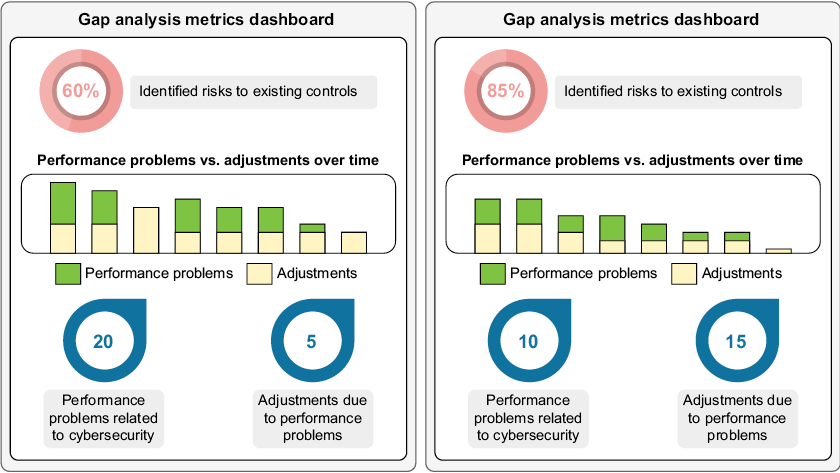
Compare the gap-analysis dashboards before and after a continuous improvement program to see how tracked metrics support oversight decisions. section 5.6.5












