Resilience is a system’s ability to self-correct after failure while continuing acceptable service or recovering without prolonged disruption. Unlike availability, which emphasizes redundancy and traffic redirection, resilience emphasizes recovery from failure events. section 1.3.3
A resilient platform turns failure handling into an architectural and operational capability:
- Protects against data loss and prolonged outages caused by events such as power or data-center failures. section 1.3.3
- Uses self-healing to restore desired state when services fail, move workloads from failing infrastructure, or adjust capacity to traffic. section 7.0
- Measures customer experience through published service-level indicators and objectives rather than treating uptime alone as sufficient. section 5.4
Response time versus outage duration
A service responding in 40 milliseconds for 99.99% of the month but suffering two outages totaling 52 minutes may provide a worse human experience than one responding in 40 milliseconds for 99.9% of the month while serving the remaining requests more slowly. Published SLOs make the chosen experience measurable and actionable. section 5.4
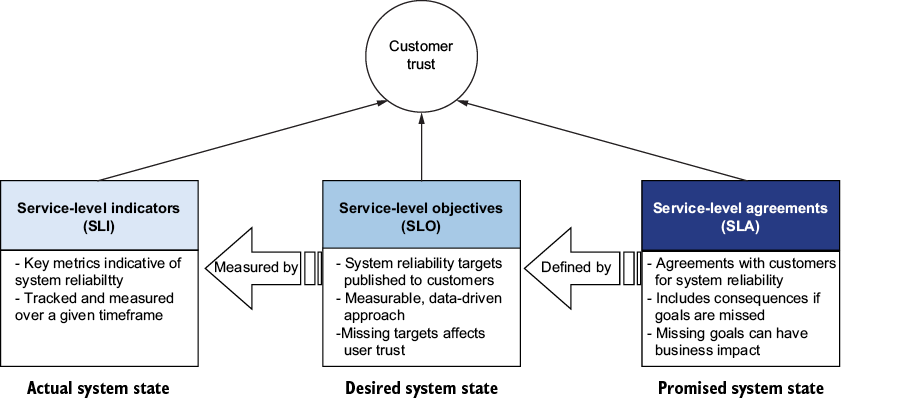
Use the SLI-to-SLO-to-SLA relationship to connect operational measurements, internal targets, notifications, and customer commitments. section 5.4












