A feature interaction is a joint effect produced by two features together. Unlike a generalized additive model, where each component depends on one feature, an explainable boosting machine can include a component that depends on a pair. section 9.5.1
The pairwise component captures behavior that neither feature explains independently. Because the model includes only selected pairs, it preserves a compact, interpretable structure instead of expanding to every possible combination. section 9.5.1 section 9.5
An EBM handles feature interactions by:
- Representing predictions as contributions from individual features and selected feature pairs. section 9.5.1
- Searching among possible pairs and retaining only the most important interactions; with 19 features, an example model considers 171 pairs but keeps 10 by default. section 9.5.2
- Training interaction components in a second cyclic stage after learning individual-feature components. section 9.5.1
- Showing each pair's contribution directly in local explanations and dependency-style visualizations. section 9.5.2
Diabetes diagnosis
An EBM using age, blood glucose level, and body mass index could include all three individual components but retain only one pair, such as the most significant interaction among the three possible pairs. In bank-marketing predictions, month × day_of_week is an example of a pairwise feature with a positive contribution for a particular customer. section 9.5.2
Figure 9.21 An EBM is a generalized additive model consisting of nonlinear components that depend on only one feature as well as nonlinear components that depend on pairs of features. This example shows an EBM for diabetes diagnosis dependent on three variables: age, glc, and bmi. Though there are three pairs of variables (age-glc, glc-bmi, age-bmi), this EBM includes only one of them that it has deemed significant. The explainable boosting model is also an ensemble.
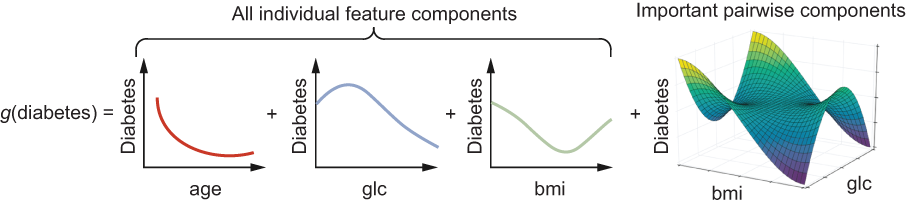
Use the figure to compare single-feature components with a selected pairwise component and see how interaction sparsity supports interpretability. section 9.5.1



