Feature interactions combine signals or encode dependencies that change a model’s behavior and the way features are computed. In production, those dependencies determine calculation order, parallelization, serving-time data requirements, and whether a real-time SLA is achievable. section 11.1.1 section 11.1.2
Use feature interactions to expose relationships that individual features may hide, while checking their operational cost.
- Combine total rides and total distance into average distance per ride to capture driver or passenger behavior. section 11.1.2
- Compare product sales with other products in the same category or with earlier periods to reveal patterns and trends. section 11.1.2
- Prioritize interactions for linear models when combining features may make the data linearly separable. section 11.1.2
- Record dependencies and versions, then test and monitor interactions because fragile or unavailable inputs can destabilize predictions. section 11.1.1
Average distance per ride
A ride model may start with total rides and total distance. Dividing the latter by the former creates a combined signal that can describe usage more meaningfully than either absolute count alone. section 11.1.2
Figure 11.1 An overview of the DeepETA model pipeline: example of combining base feature engineering and a deep learning model (source: https://mng.bz/0MoN)
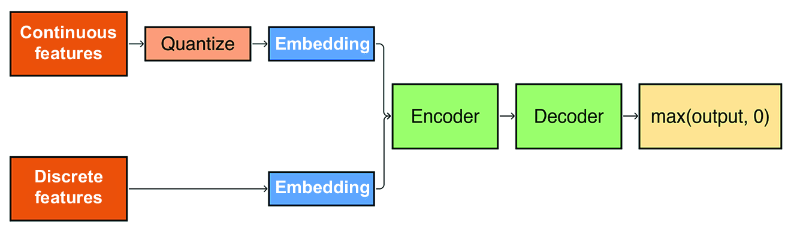
Use the pipeline view to see how base feature engineering can feed a deep learning model through combined signals. section 11.1.2



