Feature scaling transforms molecular descriptors into comparable numerical ranges before model fitting. Without it, differently scaled variables distort the cost-function landscape, so gradient descent follows an inefficient path and converges slowly. section 4.2.3
Use feature scaling when:
- Gradient-based models need similarly scaled inputs to avoid one feature dominating optimization. section 4.2.3
- Distance-based methods such as support vector machines and k-nearest neighbors compare features on compatible scales. section 4.2.3
- Decision trees and random forests generally do not require it because they are scale-invariant. section 4.2.3
- Prefer StandardScaler for molecular data with extreme values; min-max scaling can squash most observations near zero when outliers are present. section 4.2.3
Scale solubility descriptors without leakage
Fit the scaler on training descriptors, then transform both training and validation descriptors with that fitted object. For example, StandardScaler(with_mean=True, with_std=True) can fit X_train before producing scaled_X_train and scaled_X_val. Never fit the scaler on validation or test rows. section 4.2.3 section 6.2.3
Figure 4.14 Effect of feature scaling on the convergence of gradient descent.
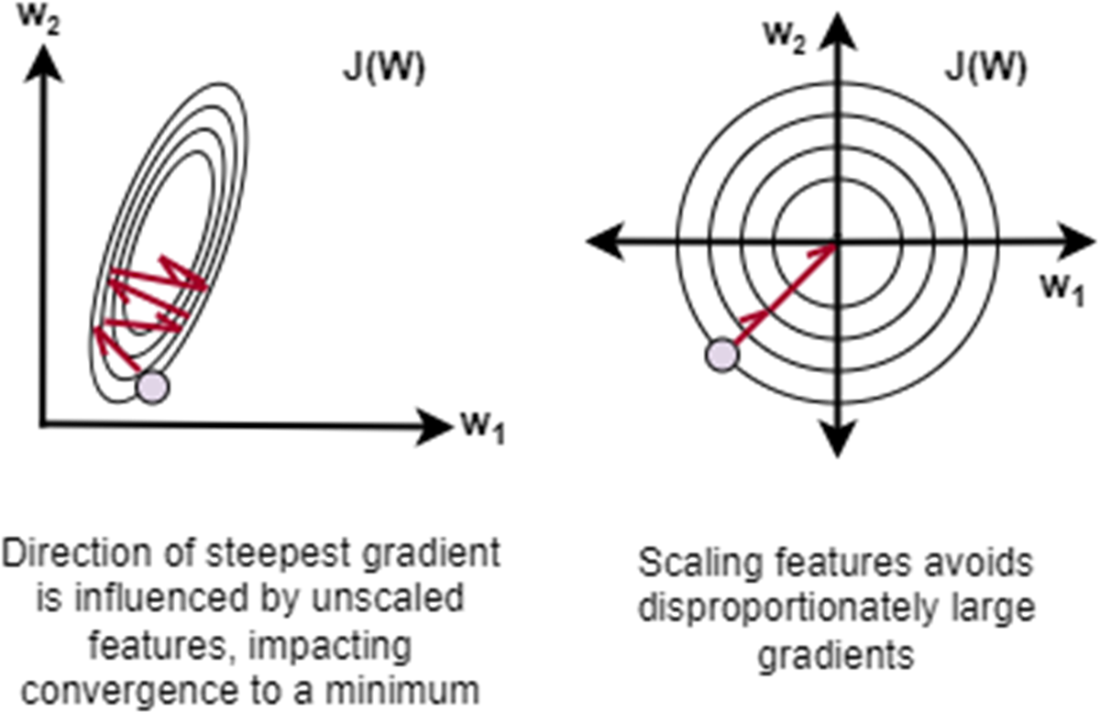
Visualizes how comparable feature scales make the gradient-descent path less elongated and more direct toward the optimum. section 4.2.3





