A feature space represents objects as points whose coordinates encode measurable features. An apple at (5, 3) and an orange at (3, 4) can be compared through their positions and distances. section 2.5.1
In ligand-based screening, molecular fingerprints act as coordinates in a binary feature space. Nearby points indicate greater feature similarity, while distance indicates dissimilarity; Tanimoto and Dice coefficients quantify this relationship. section 2.5.1
Machine-learning workflows can transform data into a nonlinear feature space when linearity assumptions fail, then fit a model that remains linear in its weights. Cross-validation, regularization, and careful curation support generalization. section 3.5
Comparing molecules
Represent two molecules with fingerprints, then compare their shared and total nonzero features using Tanimoto or Dice similarity. A higher score indicates greater fingerprint overlap. section 2.5.1
Figure 2.16 Mathematical definition of Tanimoto and Dice similarity coefficients with example computation for assessing the similarity of molecule A to molecule B.
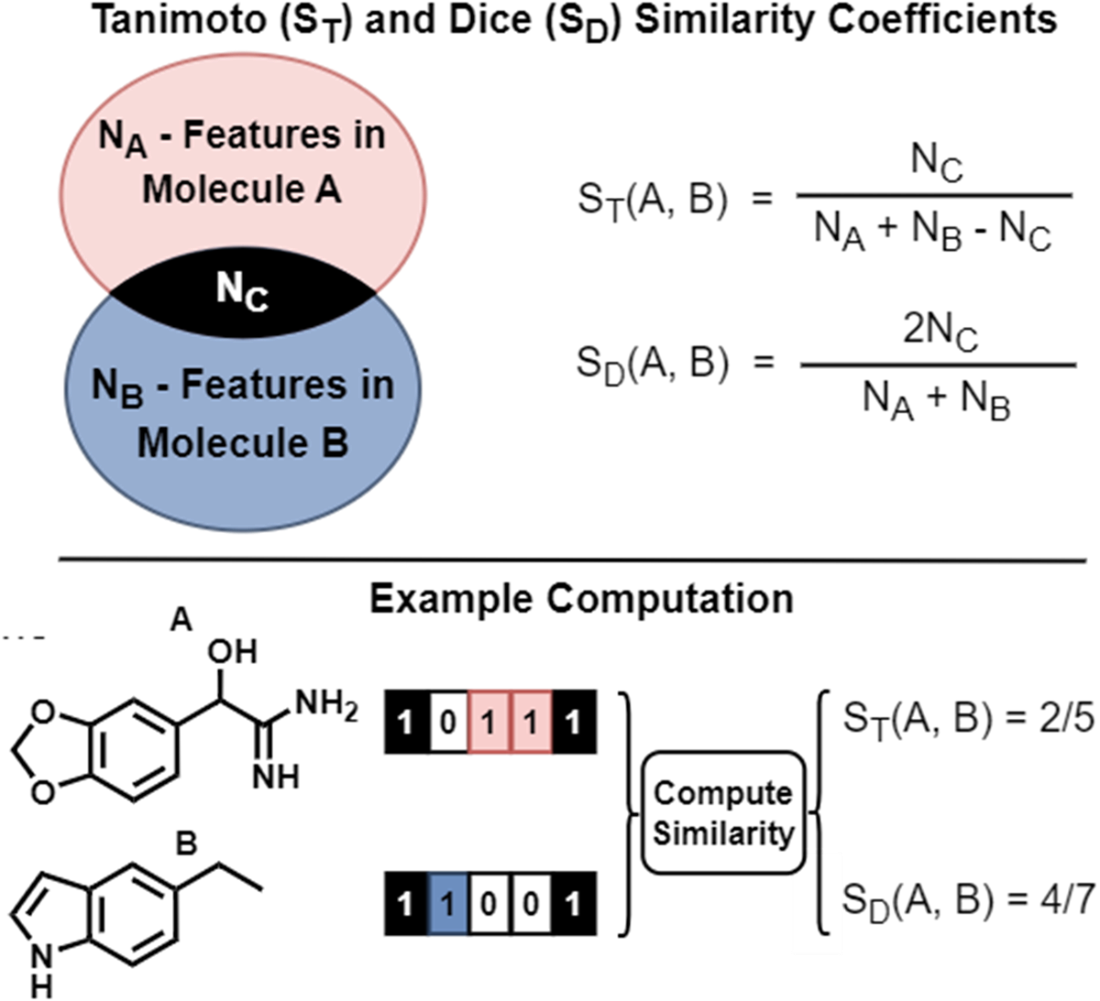
Use the coefficient definitions and worked computation to inspect how molecular fingerprint overlap becomes a similarity score. section 2.5.1


