A feature space is the geometric space defined by the features used to represent observations. Each feature supplies an axis, and each observation becomes a point. For temperature safety, low and high readings may both be unsafe while moderate readings are safe; no single threshold on the temperature axis separates the classes. section 8.1.2
Adding squared temperature as a second coordinate maps each reading t to (t, t²). This polynomial transformation changes the points’ geometric arrangement, not the observations or their labels: a straight line can separate classes that a one-dimensional threshold cannot. This boundary is a hyperplane; the example demonstrates separation, not the maximum-margin boundary. section 8.1.2
SVMs can use richer feature spaces to make nonlinear patterns linearly separable. Manually adding squared features is one approach; kernel methods let SVMs operate in transformed spaces implicitly. section 8.1.2 section 8.0
Figure 8.3 Mapping each temperature reading into a two-dimensional feature space defined by temperature and temperature squared makes the classes linearly separable. The points are schematic rather than exact functional values. The dashed line is a hyperplane separating the safe observations, shown as circles, from the unsafe observations, shown as squares. It demonstrates possible separation, not the optimal maximum-margin boundary.
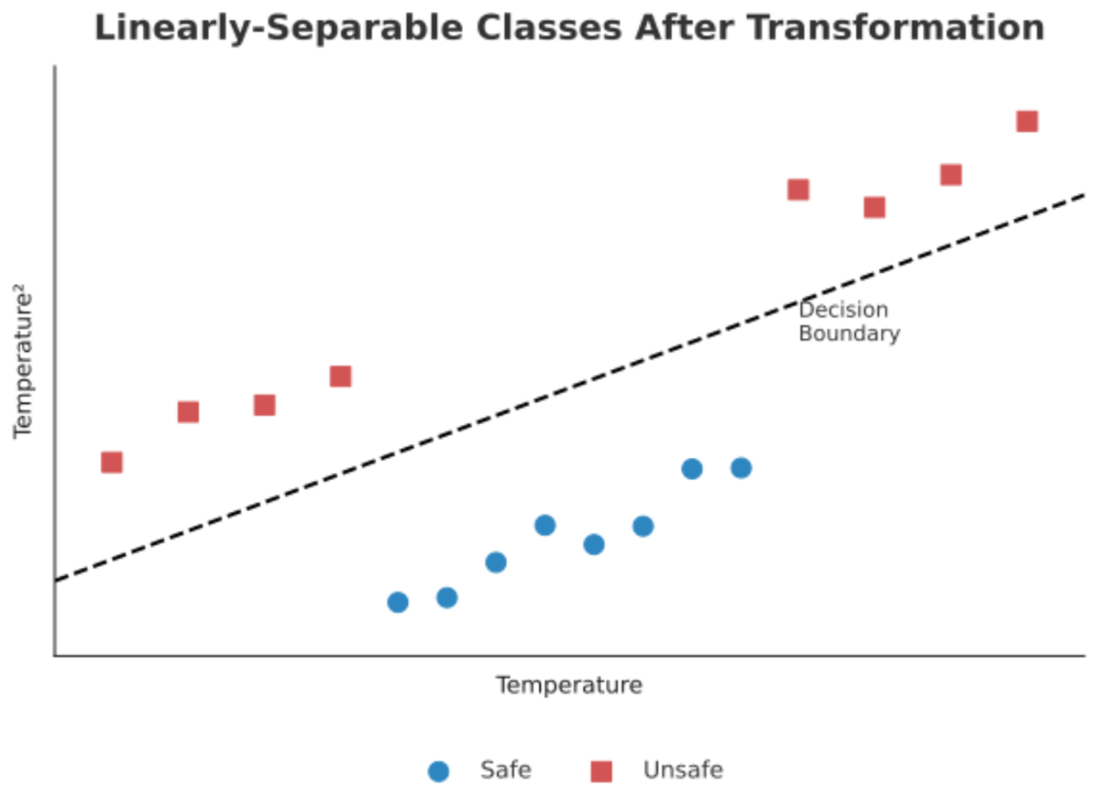
The diagram shows temperature readings mapped to temperature and temperature-squared coordinates, where a line separates the classes. section 8.1.2


