A feed-forward network sends signals generally in one direction through successive layers without feedback loops. Each neuron combines input values with weights using a dot product, then applies a usually nonlinear activation function. section 7.2
A typical network combines these parts and processes:
- Layers of neurons transform floating-point inputs into outputs; a simple arrangement can contain input, hidden, and output layers. section 7.2
- Nonlinear activation functions let the network represent nonlinear problems; without them, the whole network would remain a linear transformation. section 7.2
- Backpropagation evaluates the final error and distributes corrections backward, updating weights with deltas, prior inputs, prior weights, and a learning rate. section 7.2
Deploying a trained model
A photo app can download a pretrained image-classification model, place it in Apple’s Core ML, and use it without ongoing training. Training is more computationally expensive than using the trained network. section 7.7
Figure 7.2. A single neuron combines its weights with input signals to produce an output signal that is modified by an activation function.
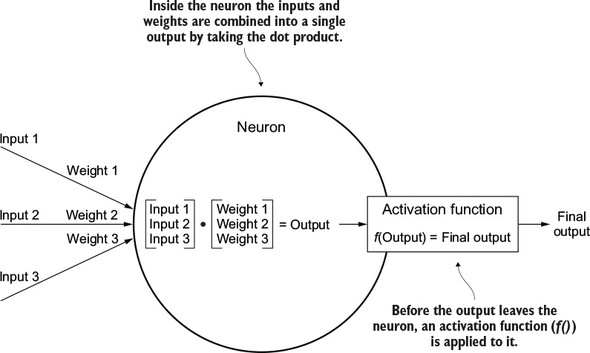
A neuron diagram makes the basic forward operation visible: combine weights and input signals, then modify the result with an activation function. section 7.2












