A lender deciding whether to approve a loan needs more than a prediction. It needs a decision that uses reliable data, follows lending policy, and can be monitored as risk changes. AI in finance applies techniques such as machine learning, natural language processing, and anomaly detection to financial data and workflows. Its uses extend from credit and fraud decisions to investment intelligence and customer experience. section 1.1 section 1.0
A financial AI application connects four layers:
- Data assets: bring together relevant sources, which may be structured or unstructured, static or streaming. section 1.1 section 1.4
- Modeling: turn data into predictive or generative signals. section 1.4
- Strategy and monitoring: apply decision rules and track whether signals remain useful as conditions change. section 1.4 section 1.7
- Application: deliver governed decisions into a working financial process, rather than stopping at a trained model or user interface. section 1.0 section 1.4
Credit-scoring workflow
Raw borrower data becomes a signal such as predicted probability of default. Lending policy then uses that signal to guide a decision. Assessment must also account for interpretability, irregular data, changing risk profiles, fair-lending obligations, and the cost of misclassification; predictive performance alone is not enough to put a model into production. section 1.1 section 1.7 section 4.5
Financial AI is an evolving system. Outcomes feed back into data, models, thresholds, and operations as markets, regulations, and user behavior change. Explainability, fairness, compliance, and precision therefore shape development and deployment—not just a final review. section 1.4 section 1.7 section 1.1
Figure 1.3 Financial AI applications aren’t just trained models or UIs. They connect curated data assets, predictive or generative models, strategy and monitoring rules, and application workflows. Feedback from real-world outcomes flows back into the system, helping teams refine data, models, thresholds, and operational decisions over time.
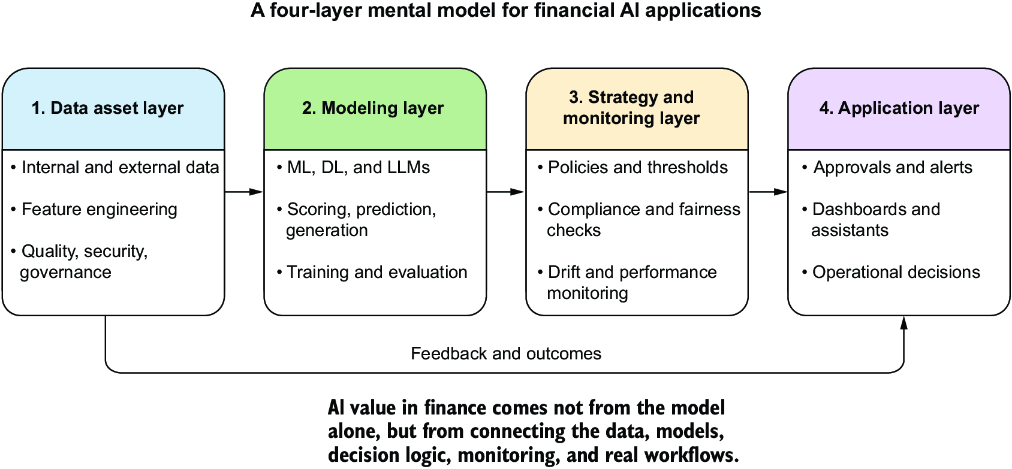
The four-layer diagram shows how data, models, governed decisions, application workflows, and outcome feedback fit together. section 1.4
