Operational efficiency in security means keeping services available and limiting the time and cost of incident disruption. For operations leaders, useful evidence includes system uptime, downtime, and incident response time. Finance leaders may also need the resulting cost savings. section 4.3.3 section 4.3.4
A healthcare security investment
After a $500,000 investment in AI-driven threat detection, incident response time fell from 24 hours to 4 hours. The reported results also include 99.9% system uptime, no unplanned downtime affecting healthcare delivery, and $500,000 in operational costs saved through reduced incident downtime. A separate $2.5 million breach-prevention estimate depends on a breach that did not occur; keep that estimate distinct from the operational results when presenting the investment’s $3 million stated total value. section 4.3.4
Figure 4.5 Example slide 4: Incident response time improvements before and after investment.
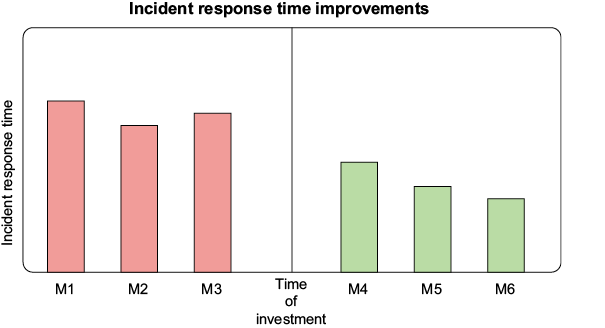
Compare incident response time before and after the investment to show one measurable contribution to operational efficiency. section 4.3.4
Lead with faster response and service availability when speaking to operations teams. For finance, connect reduced downtime to operational savings, and label estimated breach-prevention savings separately. This keeps the recommendation tied to each audience’s decision. section 4.3.3 section 4.3.4