liveBook · Manning

Five Whys

As explained in Machine Learning System Design

A questioning technique that repeatedly asks why to trace a problem toward its underlying origin.

Five Whys is a problem-space technique that stacks “why?” questions to move beyond an apparent request and identify the problem’s underlying origin before implementation begins. section 2.1

Use the questions to clarify what should be built and why:

  • Why do we need the solution, and what problem does it solve? section 2.1
  • Why does the problem occur, and what alternatives are known? section 2.1
  • Why must the solution work within constraints such as metrics, latency, or training-sample limits? section 2.1

From request to underlying need

A request for a lead-scoring tool becomes more precise by asking what problem it solves, when scores are needed, and why the stated operational constraints matter. The resulting requirement may specify scores before Monday sales-planning meetings. section 2.1

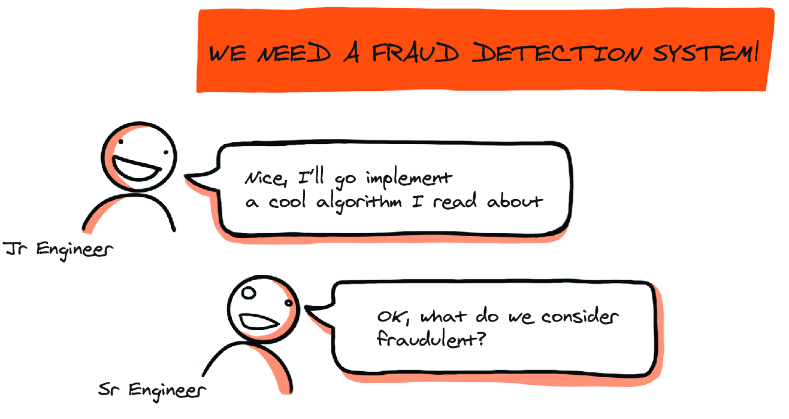
Figure 2.1 An experienced engineer always handles the problem space first with specifying questions.
figure

Use the problem-space diagram to distinguish specifying questions from premature solution design. section 2.1


How Machine Learning System Design covers it

How deep it goes
Defines chained why-questions and gives practical prompts, but stops short of prescribing implementation details.
Examples
Uses a lead-scoring requirement and questions about purpose, causes, alternatives, metrics, latency, and training samples.
What it assumes
Assumes a proposed solution or problem context, while teaching practitioners to investigate its purpose before implementation.
What you can do after
Evaluate and understand what to build, why it matters, and which constraints shape the requirement.
How it connects
Connects problem space with solution space, customer needs, functional requirements, and implementation constraints.

Also explained in

Compare how 4 books explain Five Whys →

Related concepts

This explainer was generated by Manning's knowledge graph from the text of Machine Learning System Design. The section links point to the parts of the book it draws on.

