A reconnaissance agent gathers and interprets information about a target environment, then chooses or refines the next information-gathering step. It can read system and network logs, reason over naming patterns, predict likely administrative endpoints, and adjust queries as conditions change. Its role is to reduce the manual, snapshot-based nature of testing while keeping decisions reviewable. section 1.3.2 section 4.1
A practical agent is a pipeline rather than an opaque loop. Small stages perform bounded tasks, pass explicit outputs forward, and record durable artifacts. This makes an interrupted run resumable and lets an analyst trace a finding to the command, parameters, and time that produced it. section 4.1 section 4.3
A minimal reconnaissance-agent design centers on these operational properties:
- Defined scope: establish the minimum viable pipeline and make clear what is included and excluded. section 4.2
- Artifact flow: save each stage's structured result so later stages and reviewers use the same evidence. section 4.1 section 4.3
- Adaptive decisions: use observed signals to select follow-up queries, patterns, or actions during an operation. section 1.3.2
- Safety gates: enforce time windows, approval checks, and scope filters; let people decide which proposed actions execute. section 4.1
Figure 4.1 Our passive reconnaissance pipeline. The pipeline gathers information about a target domain and its subdomains. For each discovered subdomain, the pipeline queries DNS servers to retrieve the IP addresses to which the subdomain points. The pipeline then sends an HTTP HEAD request to each live subdomain. If the subdomain uses HTTPS, the pipeline examines the TLS/SSL certificate, checks for Application Layer Protocol Negotiation (ALPN), and inspects the Subject Alternative Name (SAN). All this information gets written to JSONL.
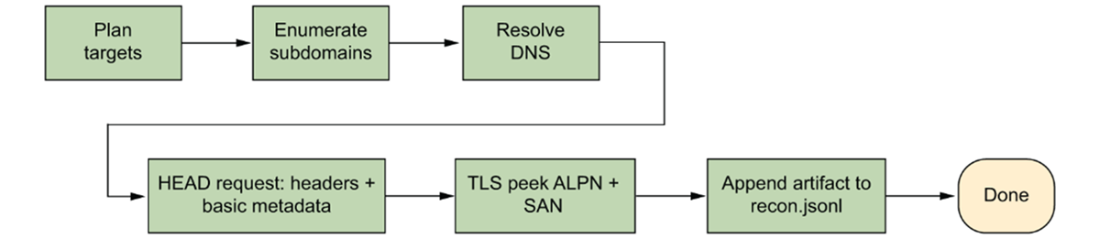
A passive pipeline illustrates artifact-driven reconnaissance: discover subdomains, resolve DNS, check live services with HTTP HEAD, inspect HTTPS certificate details and ALPN, then write the observations to JSONL. section 4.1
Passive domain reconnaissance
For a target domain and its subdomains, the agent can resolve IP addresses, send HTTP HEAD requests to live subdomains, and, when HTTPS is present, inspect TLS/SSL certificate information, ALPN, and Subject Alternative Names. The resulting JSONL becomes a durable record for review and reruns. section 4.1
Autonomy must stay inside operational boundaries. A reconnaissance agent may flag a new framework pattern or propose a follow-up action, but approval and scope controls constrain execution. A minimal implementation is a foundation, not a production-ready system; use it only in a sandbox until safety and audit components are in place. section 1.3.2 section 4.1 section 4.3
