A credit decision or fraud check needs more than a model: it needs governed data, a decision process, a working application, and a way to detect when performance changes. Four-layer architecture separates those responsibilities so a financial AI system can adapt without treating its model or interface as the whole product. The layers are a design map, not a required team structure or deployment order. section 4.3 section 7.4.6
Assign each responsibility to a layer:
- Data asset: govern data sources and build the pipelines and features that supply models or other system components. section 4.3 section 10.1.1
- Modeling: implement predictive engines; in an agent system, combine traditional ML outputs with LLM-based interpretation. section 10.1.1 section 14.1.2
- Strategy and monitoring: set the decision approach, test it, manage risk, and watch outcomes. Credit monitoring can use K-S, AUC, and PSI to check performance and stability. section 10.1 section 4.3.5
- Application: put decisions to work, such as executing a live trading strategy or running an agent that observes, reasons, plans, and acts. section 10.1.1 section 14.1.2
From investment idea to live strategy
An investment workflow places its philosophy, backtests, and risk controls in strategy and monitoring; data pipelines and feature engineering in data assets; predictions in modeling; and live execution in the application. Deployment must also account for transaction costs, slippage, and performance degradation. This separates the chronological steps of the work from the responsibilities of the system. section 10.1.1 section 10.1
Decoupling also helps fraud systems change without disrupting subsecond payment authorization: a team can upgrade a streaming pipeline, replace a rule engine, or add asynchronous LLM-assisted investigation independently. In regulated agent workflows, the same architecture adds human approval to strategy and monitoring rather than assuming autonomous proposals should execute unchecked. section 7.4.6 section 14.1.2
Figure 14.1 The four-layer framework extended for agentic systems. The fundamental structure remains intact, but each layer’s implementation changes. The data asset layer now exposes data through callable tools. The modeling layer expands from traditional ML to include LLM-based reasoning. The application layer becomes an agent executor rather than a simple API. The strategy and monitoring layer adds HITL governance alongside traditional metrics.
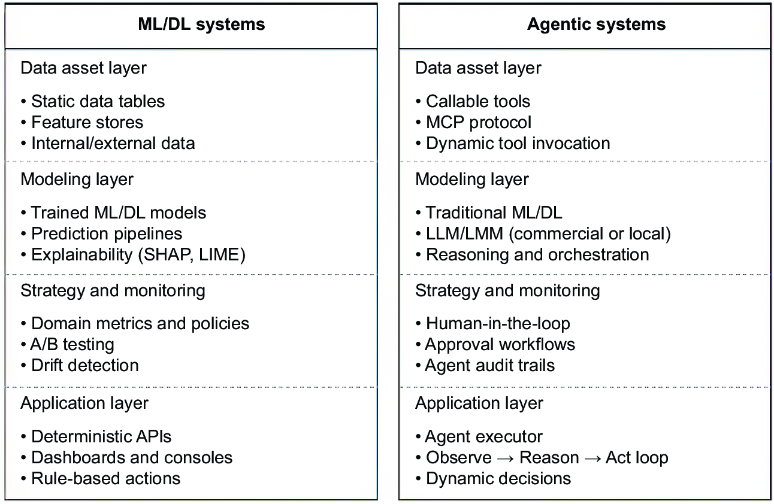
Compare how the four responsibilities persist when data becomes callable tools, modeling includes LLM reasoning, the application becomes an agent executor, and monitoring adds human-in-the-loop governance. section 14.1.2
