Function approximation estimates the outputs of a target function without necessarily reproducing its exact form. In machine learning, the approximator maps inputs to results or predictions; evolutionary methods can instead evolve the function itself. section 12.1 section 4.4
The method can use deep learning, evolutionary strategies, or differential evolution. Evolutionary strategies control mutation with additional strategy vectors, while differential evolution reduces differences between candidate solutions without calculus and can address continuous or discontinuous functions. section 4.4 section 4.5
A practical evolutionary workflow includes:
- Define a target function and a set of expression operators. section 12.1
- Compile each candidate expression, generate predictions for sample inputs, and calculate mean absolute error as fitness. section 12.1
- Configure genes, head length, chromosomes, mutation, crossover, population size, generations, and elite retention. section 12.1
- Inspect the best individual, simplify its expression, and export its expression tree. section 12.1
Evolving a linear function with Geppy
Set the target to f(x1) = 6*x1 + 22, use addition, subtraction, multiplication, and protected division as operators, then evolve a population of 100 individuals for 100 generations. Simplifying the best individual can produce 6*x1 + 22. section 12.1
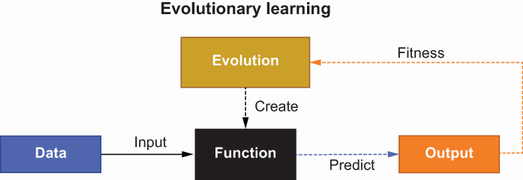
Use the evolutionary-learning figure to trace how candidate functions are evaluated and improved. section 12.1

