Function approximation treats machine learning as the search for a model that maps inputs to desired outputs when the true transformation is unknown. Training adjusts tunable parameters, or weights, so model outputs match known examples; inference applies the resulting function to new inputs. section 1.2
A weighted sum is the simplest model architecture, but many real classification and estimation problems require nonlinear functions. Applying a nonlinear activation such as the sigmoid to a weighted sum creates a more expressive model for complex decision boundaries. section 1.6
Neural networks extend approximation capacity through perceptrons:
- A single perceptron can represent linearly separable logical functions such as AND, OR, NOT, and voting. section 7.3.4
- XOR cannot be represented by one perceptron but can be modeled by combining multiple perceptrons. section 7.3.4
- A single hidden layer can approximate most functions to arbitrary accuracy in principle, although complicated targets may require many perceptrons; practical models often use multiple layers. section 7.3.4
A perceptron as a geometric function
For binary inputs, weights w₀ = w₁ = 1 and bias −1.5 produce y = ϕ(x₀ + x₁ − 1.5). The threshold separates the input plane at x₀ + x₁ = 1.5, assigning 1 only when both inputs equal 1, which implements AND. section 7.3.4
Figure 7.11 Geometrical views for the perceptrons in figure 7.10. Each dot represents an input point(a [x0 x1] vector). The shaded dots map to an output value of 1, and the unshaded dots map to an output value of 0. The thick line indicates the decision boundary.
|
(a) Logical AND decision boundary: x0 + x1 = 1.5 |
|
(b) Logical OR decision boundary: x0 + x1 = 0.5 |
|
(c) Logical NOT decision boundary: x0 = 0.5 |
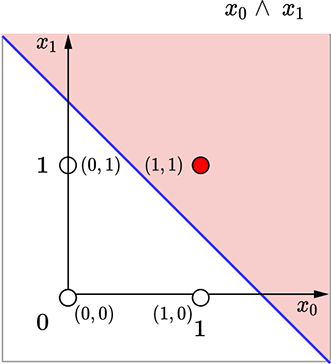
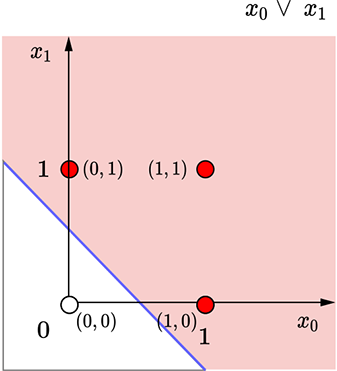
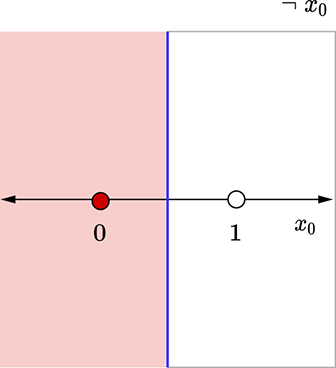
Use the decision-boundary diagrams to connect perceptron parameters with geometric partitions of the input space for AND, OR, and NOT. section 7.3.4

