liveBook · Manning

Game tree

As explained in Applied Reinforcement Learning

A game tree is a tree representing possible states and moves in a strategic game or other sequential decision process.

A game tree maps a sequential decision problem as states connected by possible moves. Each node represents a game or environment state; each branch represents a move. Monte Carlo Tree Search operates on this kind of tree. section 7.1

Route planning

Start at a depot, branch into North or South routes, then branch again by which customer to visit first. Each node records a location or decision and its cost. section 7.1

Figure 7.1 Tree data structure in vehicle route planning problem
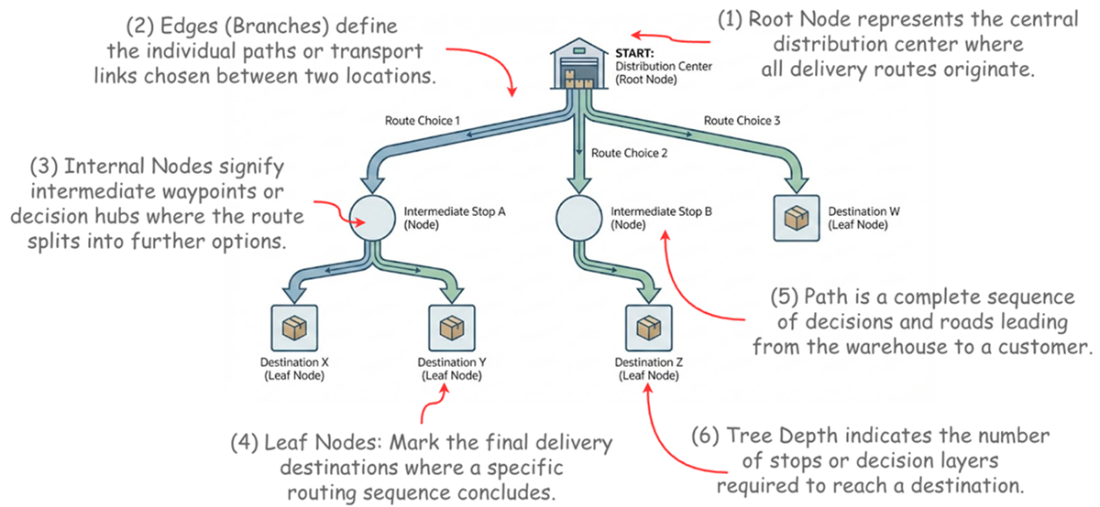
View the branching route-planning tree. section 7.1


How Applied Reinforcement Learning covers it

How deep it goes
Defines nodes and branches, then demonstrates a small route tree with Python code.
Examples
Illustrates branching choices with depot routes, delivery zones, and customer visit order.
What you can do after
Build it from scratch as a Python tree of route decisions, costs, and child nodes.
How it connects
Connects game trees to Monte Carlo Tree Search, decision trees, and tree data structures.

Also explained in

Compare how 3 books explain game tree →

Related concepts

This explainer was generated by Manning's knowledge graph from the text of Applied Reinforcement Learning. The section links point to the parts of the book it draws on.
