A Gaussian mixture model (GMM) represents an unlabeled, multi-cluster distribution as a weighted combination of Gaussian components. It is useful when one Gaussian cannot match the overall point cloud but each natural cluster can be approximated by a Gaussian. A component can correspond to a class, allowing the fitted distribution to generate similar samples or assign inputs to clusters. section 6.0 section 6.9
A GMM has K components with mixture weights πk, means μk, and covariances Σk. K controls the number of peaks or clusters; πk controls their relative heights; μk sets peak locations and cluster centroids; and Σk controls the shape and spread. The weights form probabilities over components, so they combine the component densities into one proper distribution. section 6.9.1 section 6.9.2
Height and weight clusters
Unlabeled height data for adult females and adult males can be modeled with two one-dimensional Gaussians. Unlabeled height-and-weight data for adult females, adult males, and children can be modeled with three two-dimensional Gaussians. Their combined density has separate bell-shaped peaks even though the observed data carries no class labels. section 6.9
Figure 6.8 Various GMMs (solid curves) with the same Gaussian components (dotted and dashed curves, respectively) but different π1 and π2 values
|
(a) Gaussian components μ1 = 152, μ2 = 175, σ1 = σ2 = 9 |
|
(b) GMM with π1 = 0.5, π2 = 0.5 |
|
(c) GMM with π1 = 0.7, π2 = 0.3 |
|
(d) GMM with π1 = 0.3, π2 = 0.7 |
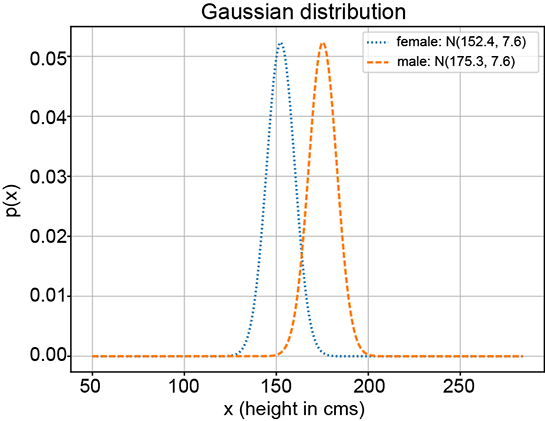
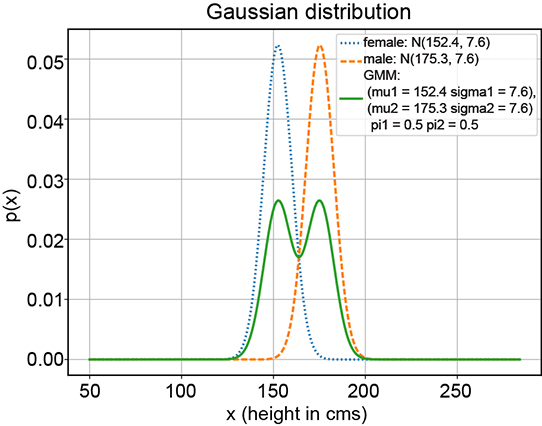
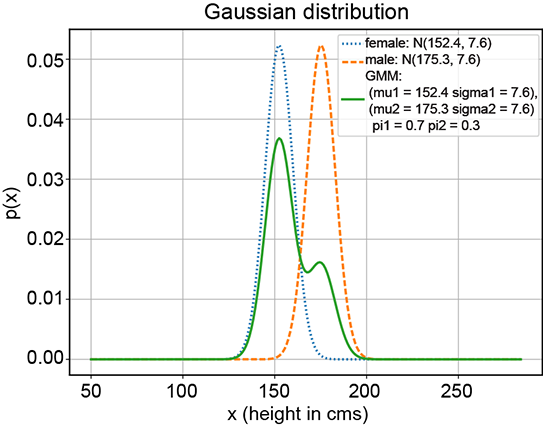
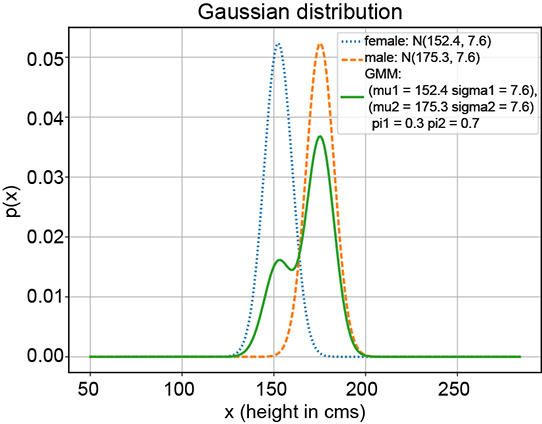
Compare mixtures built from the same two Gaussian components while changing π1 and π2 to see how weights alter the combined density's peak heights. section 6.9.1
A latent categorical variable Z selects a component. Z = k means that the kth Gaussian class was selected; its prior probability is πk, while the observed input is drawn from that component's Gaussian density. Marginalizing over Z yields the overall GMM density. section 6.9.2
A fitted GMM supports classification and parameter estimation:
- For an input x, compute the posterior probability of every component and assign x to the component with the largest p(Z = k | X = x). This resembles choosing the closest mean while accounting for each cluster's variance. section 6.9.3
- Fit πk, μk, and Σk from unlabeled points by maximum likelihood. Unlike a single Gaussian, a GMM has no closed-form MLE here, so parameters are iteratively updated through E-steps and M-steps until likelihood stops increasing. section 6.9.4


