GitOps is an operational model in which system configuration and deployments are described declaratively in version-controlled repositories. Separate teams maintain configuration sets, while shared interfaces connect repositories, image builds, Kubernetes manifests, and delivery workflows. section 12.6 section 8.3.2
A GitOps implementation assigns responsibility across several operational boundaries:
- Store infrastructure, platform, and application definitions as configuration files in version control. section 12.6
- Use Kubernetes manifests as a common interface between development, operations, security, and delivery responsibilities. section 12.6
- Apply manifests declaratively and asynchronously, including manifests defining VirtualMachine custom resources. section 8.3.2
- Choose a single cluster with multiple namespaces for single-site or nonproduction setups, or multiple clusters for high availability, global latency, and staged rollout needs. section 12.6
Multi-cluster application delivery
A microservices voting system runs on an Anthos GKE cluster with separate Voting, Transfer, and Results namespaces. For broader availability or lower rollout impact, multiple clusters can receive the application incrementally before full release. section 12.6
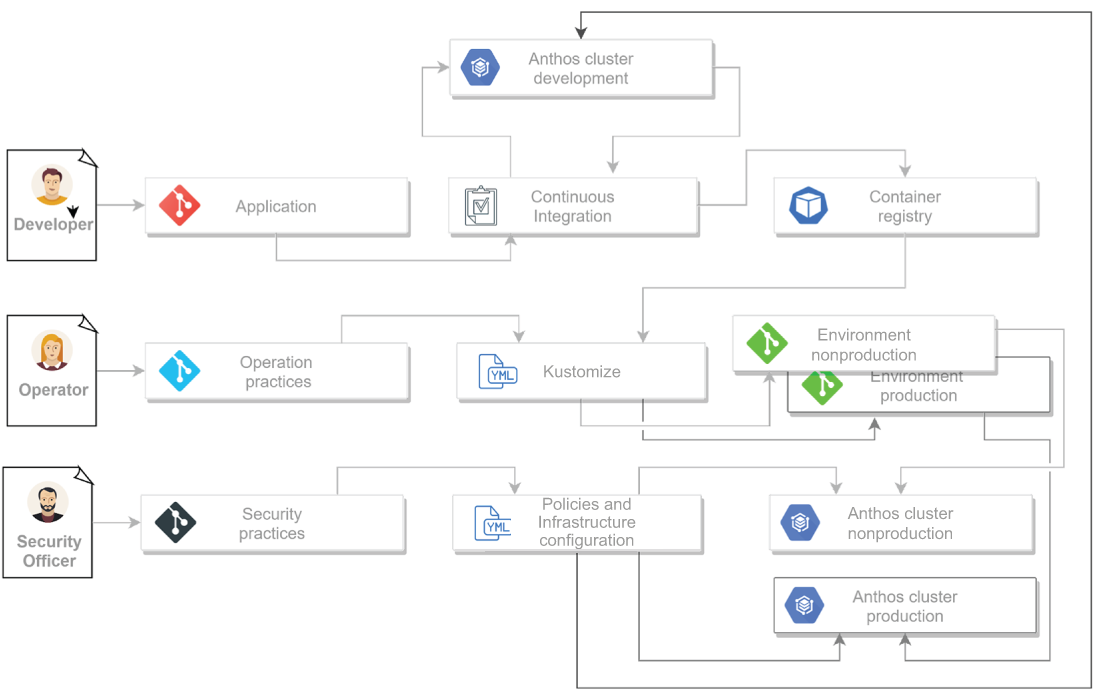
Use the application delivery workflow to trace how repositories, builds, manifests, and deployment targets connect. section 12.6
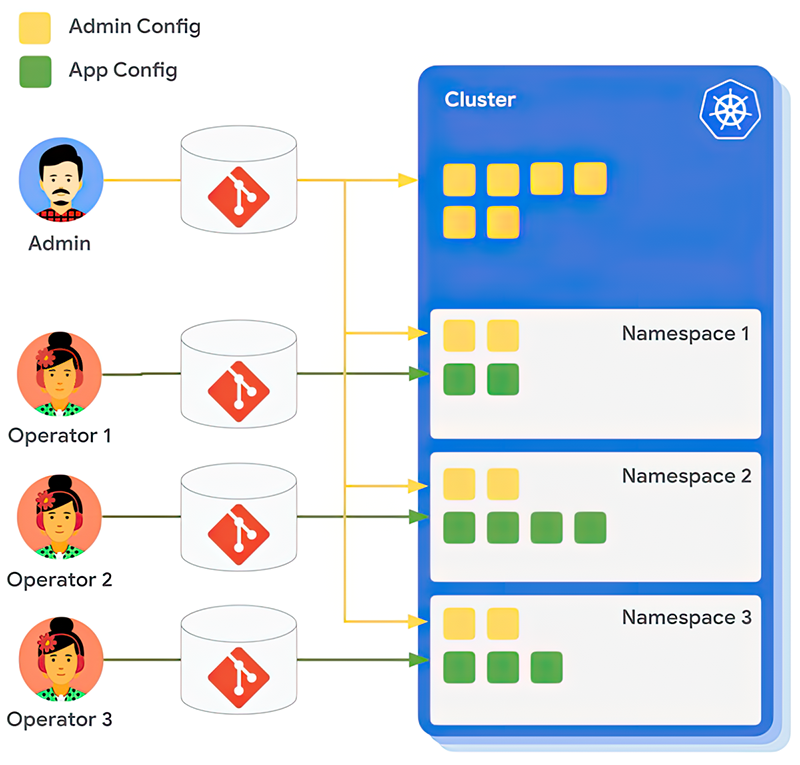
Use the multiple-repository diagram to examine how Anthos Config Management synchronizes configuration across a cluster fleet. section 8.3.2





